Turn $150K into $7.4M: Advocacy Budget Planning for Revenue Leaders

Start by allocating 0.4 to 0.8 FTE plus $112,000 to $168,000 annually for a mid-market reference bench, or use the 10% of renewal plus 10% of expansion heuristic if your renewal base is larger.
TL;DR:
- Advocates should be recruited continuously, targeting 8% to 12% of recent closed deals, with warm leads converting at 45% to 65%.
- A mid-market advocacy program typically requires a budget of $112,000 to $168,000 annually, including personnel, tooling, perks, and events.
- Staffing should include a program manager, RevOps support, customer success liaison, content partner, and an executive sponsor, with 0.4 to 0.8 FTE as a starting point.
- Advocacy programs must track referral-sourced pipeline, win-rate lift, cycle-time reduction, and ASP uplift to prove ROI and justify the budget.
- Implement governance rules such as follow-up, activation caps, and contingency funds to prevent shallow benches and overspending on top advocates.
Table of Contents
- Building the advocacy budget framework line by line
- Who should own the advocacy program and how many people it takes
- Recruitment math, bench sizing, and realistic timelines
- Perks, events, and Customer Advisory Board budget benchmarks
- Tooling and integration costs you need to plan for
- Metrics, attribution, and the dashboard that proves ROMI
- Common pitfalls and the governance rules that prevent them
- Positioning advocacy as revenue infrastructure, not a marketing tactic
- How Clareefai helps you fund advocacy with less guesswork
- Sources
- FAQ
Building the advocacy budget framework line by line
A funding request lands better when it mirrors how finance already thinks about cost centers. Break your ask into six lines, each tied to a job the program has to do.
- Personnel: the program manager and any partial allocations from RevOps, content, or customer success.
- Tooling: your advocacy management platform, testimonial capture, and CRM integration costs.
- Perks: gift cards, swag, and tiered rewards for advocates who give time or content.
- Events and CABs: Customer Advisory Board sessions, dinners, and any in-person gatherings.
- Analytics and attribution: dashboard build-out and reporting time.
- Operations and contingency: a buffer for onboarding leakage and unplanned advocate requests.
Two sizing methods work well together. The first is percent-of-revenue: SaaStr’s 10+10 rule suggests committing 10% of revenue up for renewal and 10% of targeted expansion dollars to customer marketing, advocacy included. The second is per-advocate math: if your CAB or reference bench needs 50 active advocates and each one costs roughly $2,200 to $3,400 fully loaded (perks, events, and support time combined), you can build the ask from the bottom up. Whichever method you use, translate the number into an influenced ARR target before you present it. If your program is expected to influence $7.4 million in ARR, a $150,000 budget is a rounding error, not a risk.
Who should own the advocacy program and how many people it takes
Advocacy fails quietly when nobody owns it full time. The Pedowitz Group notes that programs with even 30% dedicated ownership sustain reference production much better than those run as a side project. For most mid-market teams, 0.4 to 0.8 FTE of program management is the right starting point.
- Program manager: owns recruitment, matching, and advocate relationships day to day.
- RevOps or analytics support: builds and maintains the tagging and reporting layer.
- Customer success liaison: flags happy customers and routes reference requests without overloading any one account.
- Content or marketing partner: turns raw testimonials into usable assets.
- Executive sponsor: unlocks budget and lends credibility when asking top accounts for time.
When you present staffing to finance, frame it as a multiplier, not a cost. A platform that centralizes advocate matching and verification reduces the manual search time that eats into a program manager’s week, which means the same 0.5 FTE can support a larger bench.
Pro Tip: Present the program manager’s time in hours saved per match, not just salary, so finance sees the labor line as leverage rather than overhead.
Recruitment math, bench sizing, and realistic timelines
The math behind a healthy bench is straightforward once you know the assumptions. PulseRevOps recommends recruiting 8% to 12% of the trailing quarter’s closed-won accounts, then adjusting for how those asks actually convert.
- Warm asks from happy, engaged customers convert at 45% to 65%.
- Cold outreach converts at 18% to 22%, so it should never be your primary channel.
- Executive-to-executive asks convert at 75% to 88% but require sponsor time you should budget for.
- Plan for a moderate onboarding leakage rate between a “yes” and an active, usable advocate.
- Average advocate lifespan runs over a year, so expect to replenish a significant portion of your active bench periodically.
Say last quarter closed 120 deals. You land with 3 to 4 net new advocates per quarter from that cohort alone, which is why most teams run recruitment continuously rather than in bursts.
The canonical activation timeline is 8 to 12 weeks per wave, covering the ask, verification, content capture, and first activation. Compressing that window rushes verification and produces advocates who feel used rather than valued.

Perks, events, and Customer Advisory Board budget benchmarks
Perks work best when they scale with what you are asking. A tiered structure keeps spending predictable and gives advocates a clear sense of what bigger commitments earn them.
- Tier 3 (a quote or short testimonial): $250 to $500 annualized value.
- Tier 2 (reference calls or video testimonials): $1,000 to $2,500 annualized value.
- Tier 1 (CAB membership, speaking slots, case study participation): $3,500 to $8,000 annualized value.
For Customer Advisory Boards specifically, the Attendir CAB Playbook puts a lean program at $22,000 to $28,000, a standard program at $32,000 to $42,000, and a premium program at $48,000 to $55,000. Venue is the line item most teams over-budget, while dinner programming and post-event facilitation, worth budgeting separately at $4,000 to $8,000, drive most of the relationship value. Forrester also notes that non-monetary perks like speaking slots and peer introductions often outperform cash, which is worth remembering before you default to gift cards for every tier.
Tooling and integration costs you need to plan for
Software costs for advocacy programs fall into four buckets: advocacy management, testimonial capture, CRM integration, and analytics. Mid-market teams typically budget these together rather than piecing together point solutions, since integration gaps are what quietly inflate the personnel line.
- Advocacy or reference management platforms replace spreadsheets and manual tracking with a searchable, permissioned advocate database.
- Testimonial capture tools handle collection, verification, and formatting so content does not sit in an inbox.
- CRM integration ensures every reference call and testimonial gets tagged to an opportunity automatically.
- Analytics layers turn that tagging into the dashboards finance will actually read.
Calculate fully loaded tooling cost against the labor it offsets. A platform that centralizes advocate matching and verification, the way Clareefai’s platform does, can cut the hours your program manager spends hunting for the right customer to pitch. When negotiating contracts, pilot on a smaller plan first, confirm the integration works with your CRM, and ask about scale pricing before committing to an annual term.
Metrics, attribution, and the dashboard that proves ROMI
None of this budget survives a review cycle without proof. The Pedowitz Group recommends tagging every advocate touch with a program ID and a clear precedence rule: sourced deals (the advocate directly brought the lead) get counted separately from influenced deals (the advocate supported a deal already in motion).
- Referral-sourced pipeline and bookings: revenue that would not exist without the advocate touch.
- Reference-influenced win-rate lift: aim for at least a 5-point improvement on deals where a reference call happened.
- Cycle-time reduction: a realistic target is 10% to 20% faster close on influenced deals.
- ASP uplift: 5% to 10% higher average selling price is a reasonable goal when advocacy proof appears mid-funnel.
- CAC payback and ROMI: the ultimate number your CFO wants, calculated from program cost against sourced and influenced revenue.
Measure these with matched cohorts, comparing deals with an advocacy touch against similar deals without one, rather than relying on raw before-and-after comparisons. Review ROMI quarterly with your exec sponsor and check operational metrics like recruit velocity and bench health monthly.
Common pitfalls and the governance rules that prevent them
Most advocacy budgets underperform for the same handful of reasons, and each one is preventable with a small governance rule.
- No post-event follow-up: CAB and reference conversations lose value fast without a facilitation budget to capture next steps.
- Wide but shallow bench: recruiting many advocates who never get activated wastes the recruitment spend entirely.
- Over-asking top advocates: burning out your best references shortens their 14 to 18 month lifespan even further.
- Ignoring onboarding leakage: budgeting for 100% conversion from “yes” to “active” guarantees a shortfall.
Set a per-advocate frequency cap, require a consent and approval step before any story goes public, and audit your bench against pipeline demand quarterly. Set aside 8% to 10% of the total budget as contingency to cover facilitation gaps and unplanned requests.
Pro Tip: Build your contingency line before you build your perks line. Programs that skip this step almost always raid the perks budget mid-year.
Positioning advocacy as revenue infrastructure, not a marketing tactic
Advocacy budgets get approved faster when they are framed as retention and expansion infrastructure rather than a campaign line. Referred customers show measurably higher lifetime value than acquired ones, which is the argument that resonates with a CFO more than any campaign metric. Pitch a pilot quarter, show influenced ARR and payback timeline, then scale staffing and tooling once the numbers hold.
— ClareefAi
How Clareefai helps you fund advocacy with less guesswork
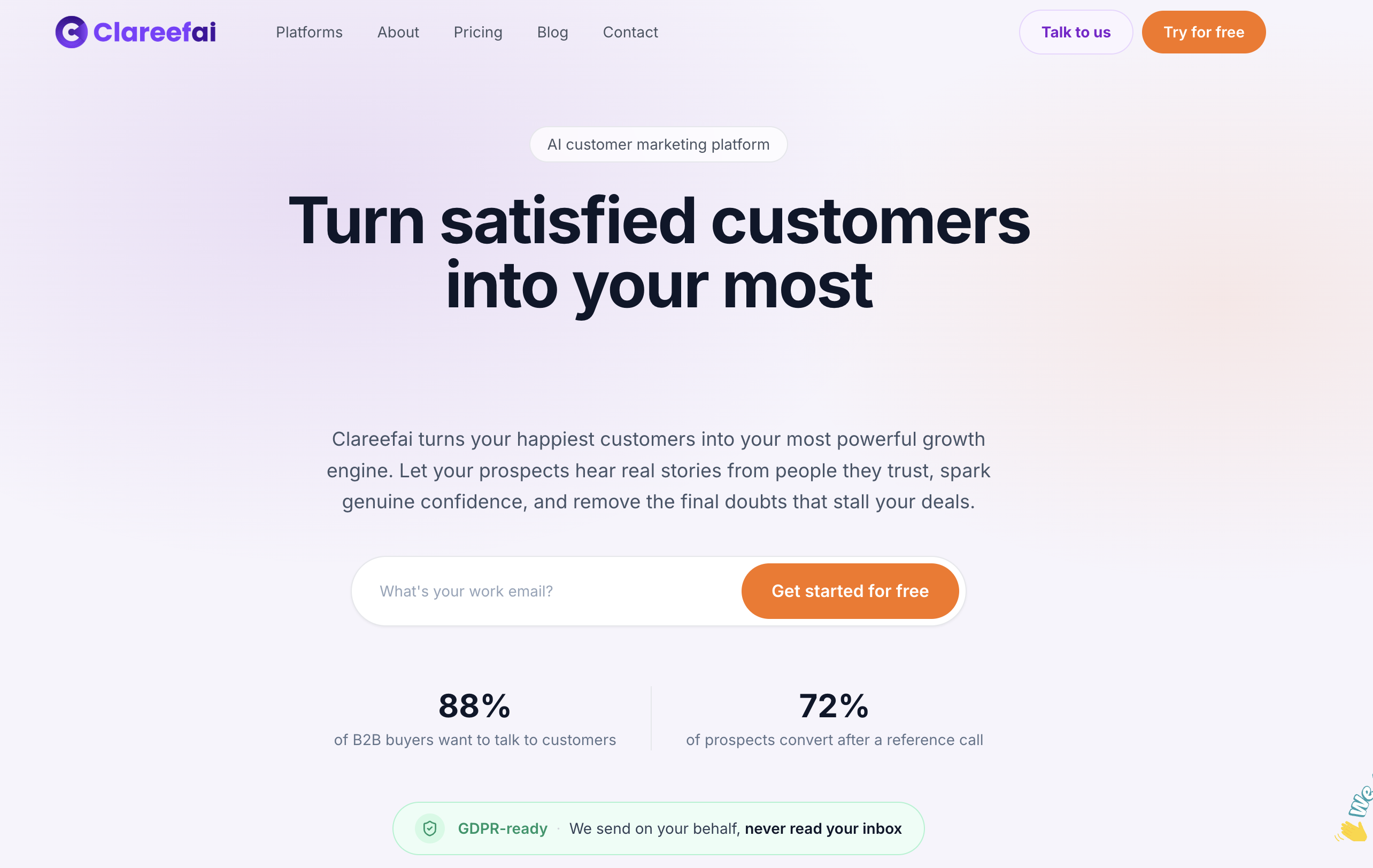
Every line item in this guide gets easier to justify when your platform does the matching and verification for you. Such a platform identifies which customers are ready to advocate, verifies their identity, and centralizes testimonials, video reviews, and reference call scheduling in one dashboard built for the roles managing the budget.
- Try the free plan to test advocate matching before committing to a paid tier.
- Compare Basic, Professional, and Enterprise pricing to size the tooling line in your budget request.
- Review the management dashboard to see how ROMI reporting maps to the metrics your CFO will ask about.
Sources
- What’s the math on recruiting customers into a reference program? — PulseRevOps
- What Metrics Measure Advocacy Pipeline Influence? — Pedowitz Group
- How Customer Referral Programs Turn Social Capital into Economic Capital — Wharton (faculty)
- How to invest in customer marketing: the 10+10 rule — SaaStr
FAQ
How much should a mid-market company budget for advocacy?
A mid-market program with roughly 50 active advocates across 500 customers typically costs $112,000 to $168,000 annually, covering personnel, tooling, perks, and events. Some teams instead use the 10% of renewal plus 10% of expansion heuristic if that produces a larger, more defensible number.
How many customers should we recruit as advocates each quarter?
Aim to recruit 8% to 12% of the previous quarter’s closed-won accounts into your reference program.
What is a realistic Customer Advisory Board budget?
Customer Advisory Board budgets typically range from $22,000 for a lean program to $55,000 for a premium one, depending on venue, travel, and facilitation. Post-event facilitation deserves its own line, often $4,000 to $8,000, since follow-up drives most of the relationship value.
How do we prove advocacy is worth the budget?
Tag every advocate touch with a program ID and track referral-sourced pipeline, win-rate lift, and cycle-time reduction against matched deal cohorts.
Should advocacy have a dedicated owner or sit inside marketing?
Programs with even partial dedicated ownership, around 30% of one role’s time, sustain far more consistent reference production than those treated as a side project, according to Pedowitz Group guidance. Most mid-market teams start with 0.4 to 0.8 FTE and add support roles in RevOps, customer success, and content as the bench grows.
Recommended
Share Article
Stay Updated
Get the latest insights on customer advocacy and SaaS growth delivered to your inbox.