Match in 24–48 Hours: Advocate Matching Algorithms for Revenue Leaders
Advocate matching algorithms identify, score, and route your best customers to the reference calls, testimonials, or case studies they’re actually a fit for, instead of leaving your team to guess from memory or a spreadsheet. The main payoff is speed and relevance: matches happen in minutes instead of days, and the advocates you tap don’t burn out from repeat requests. You’ll get the most value once you have structured advocate profiles and a CRM connection feeding the scoring engine.
TL;DR:
- Advocate matching algorithms should prioritize use case, feature relevance, and role parity, while applying a fatigue discount for advocates with recent requests.
- Starting with deterministic rules in a pilot helps validate scoring logic before layering in machine learning models trained on actual conversion outcomes.
- Reliable data collection across CRM and product telemetry is essential for accurate scoring, attribution, and measuring reference impact on sales performance.
- Limits like fatigue caps and advocate verification are crucial to prevent burnout, maintain credibility, and ensure advocate identities are trustworthy.
- Human judgment remains critical for high-stakes deals, while automation handles routine routing; systems like Clareefai streamline overall advocate management and tracking.
Table of Contents
- How Do Advocate Matching Algorithms Work?
- Which Signals Should You Weight Most Heavily?
- How Do You Roll Out Matching Algorithms Without Breaking Things?
- What Guardrails Protect Your Advocates From Burnout?
- Where Automation Helps and Where Judgment Still Wins
- Clareefai’s Approach to Automated Advocate Matching
- Sources
How Do Advocate Matching Algorithms Work?
Every matching system runs on the same basic loop: collect signals, score candidates, route the top match, and reroute if nobody responds in time. The sophistication varies, but the architecture doesn’t.
On the input side, the algorithm pulls from whatever data your stack can feed it. Common signals include:
- Net Promoter Score or CSAT responses tied to a specific account
- Product usage depth and which features an account has actually adopted
- Job role and seniority of the potential advocate
- Deal stage, industry, and company size attributes pulled from the CRM
- Past participation history, including how recently and how often someone said yes
Once signals are in place, the system needs a way to rank candidates against a request. Simpler platforms use deterministic rules. If a prospect works in healthcare and needs a reference from a similar-size healthcare buyer, the rule engine filters for that exact combination and returns whoever scores the highest on a weighted checklist. More advanced systems layer in machine learning classifiers trained on historical outcomes, meaning the model learns which past matches actually converted into completed calls or accepted testimonials, then applies that pattern to new requests.
A patent covering party-alignment scoring describes exactly this hybrid approach: modules that compute match scores from engagement history, profile attributes, and product traits, sometimes generating a three-way match among the customer, the advocate, and the specific product or use case in question. The three-way framing matters because a strong industry match with a weak product fit still produces a call that goes nowhere.

Routing logic closes the loop. A request gets sent to the top-scored advocate with an acceptance window, typically 24 to 48 hours. If there’s no response, the system automatically reroutes to the next-best match rather than waiting on a human to notice the silence. Automated routing platforms build fatigue caps and reroute-on-timeout directly into this flow, so no single advocate becomes the default answer for every request.
Which Signals Should You Weight Most Heavily?
Not every request needs the same scoring priorities. A live reference call for an enterprise deal has different stakes than a two-line testimonial for a landing page, and your weighting should reflect that.
Here’s a practical order of operations for tuning your criteria:
- Match the use case first. Reference calls need close industry and company-size alignment; testimonials tolerate more variance since the reader isn’t grilling the advocate live.
- Weight feature relevance second. If the prospect cares about a specific integration or module, prioritize advocates who’ve actually used it, not just anyone from a similar company.
- Factor in role parity. A VP-level prospect wants to hear from a VP-level advocate, not an individual contributor, even if the account otherwise fits.
- Apply a fatigue discount. Every additional request in the last 90 days should lower an advocate’s eligibility score, not just flag them for manual review.
- Set a minimum threshold, not just a top score. A best-available match that clears only 40% alignment is often worse than no match, since a poor call can damage more trust than it builds.
Adjust based on what your win-loss data actually shows drives conversions.
Pro Tip: Build fatigue into the score itself, not a separate blocklist. A soft penalty that decays over time keeps advocates in rotation without hard-cutting a great match the moment they hit an arbitrary call count.
How Do You Roll Out Matching Algorithms Without Breaking Things?
Start smaller than feels comfortable. A pilot limited to one buyer segment, say mid-market SaaS accounts in a single vertical, lets you validate scoring logic before it touches your full advocate pool. The Clareefai blog’s rollout guide recommends exactly this pattern: deploy deterministic rules first for immediate, explainable value, then layer in machine learning ranking once you have enough matched and rejected outcomes to train against.
Before you pilot anything, get your data model right. You’ll need canonical fields captured consistently across your CRM and advocacy platform:
- Deal stage and opportunity value tied to each reference request
- Persona and role data synced from your CRM, not just self-reported by advocates
- Product usage events, especially which features or modules an account has adopted
- Calendar and availability windows so routing doesn’t stall on scheduling
- A unique attribution ID connecting each match to eventual deal outcomes
Integration points matter as much as the fields themselves. Your matching engine needs a live connection to CRM deal stage (not a weekly export), product telemetry for usage-based scoring, and an attribution hook that ties a completed reference call back to a closed-won deal. Without that last piece, you can’t calculate advocate ROI or prove the program’s value to leadership.
Track three metrics from day one: time-to-match, acceptance rate, and conversion uplift on deals where a reference was used. Well-matched references correlate with 20 to 30% higher close rates and shorter sales cycles, so your pilot should be measuring against that baseline. Run the pilot for a full quarter, then iterate weights based on which matches actually converted versus which ones fizzled.
What Guardrails Protect Your Advocates From Burnout?
Algorithms make matching fast, but speed without limits wears out your best champions. Fatigue caps are the single most important guardrail: practitioner guidance recommends capping advocates at a few calls per year to prevent burnout, which also implies you need at least 15 to 20 active advocates in rotation to cover demand without leaning on the same five people every quarter.
Consent and verification deserve equal weight. Every advocate should explicitly opt in to being matched, and their identity and role should be verified before a request ever reaches them, not after a prospect asks “wait, is this person even real?” That verification step is what separates a credible advocacy program from a pile of unverifiable quotes.
Operational habits matter just as much as the scoring rules:
- Send a pre-call brief to both the advocate and the prospect so nobody wastes the first ten minutes on context-setting
- Follow up within 24 hours of any call to capture feedback and log the outcome
- Reserve live calls for genuinely high-value deals and route lower-stakes requests to case studies or recorded video instead
- Rotate advocates deliberately rather than defaulting to whoever accepted last time
Pro Tip: Track “time since last request” as a visible field on every advocate profile. It turns fatigue from an abstract policy into a number your team can see, and see it move.
Where Automation Helps and Where Judgment Still Wins
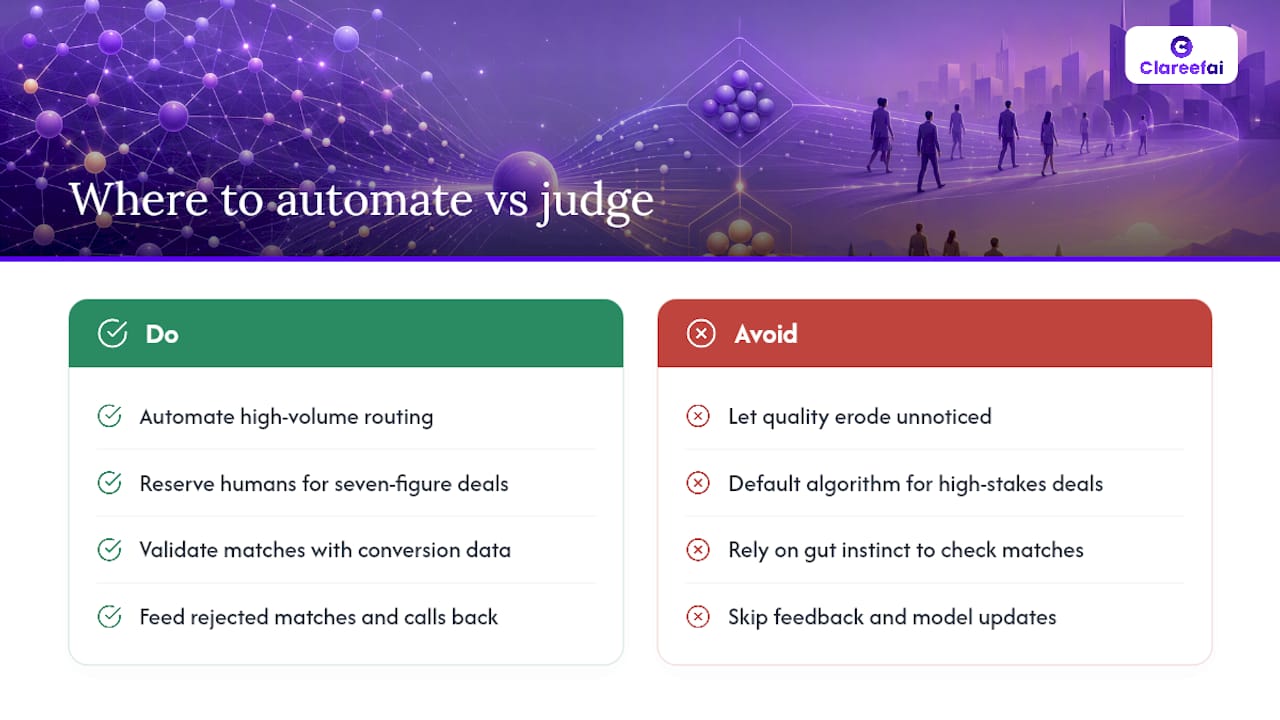
Algorithmic matching earns its keep at scale. It’s the only realistic way to route hundreds of requests a month without a coordinator drowning in Slack messages and spreadsheet tabs. But scale is exactly where quality can quietly erode if nobody’s watching the outcomes.
Reserve human judgment for your highest-stakes deals. A seven-figure enterprise opportunity deserves a curated match, one your team hand-picks and briefs personally, not the algorithm’s top score by default. Everywhere else, let the system run and check its work through conversion data, not gut instinct. Feed the pilot’s rejected matches and completed calls back into the model, and the scoring only gets sharper from there.
— ClareefAi
Clareefai’s Approach to Automated Advocate Matching
Clareefai is the practical alternative to running advocate matching through spreadsheets and Slack threads. It handles AI-driven promoter identification, verification, and fatigue-capping in one system instead of three disconnected tools your team has to babysit.
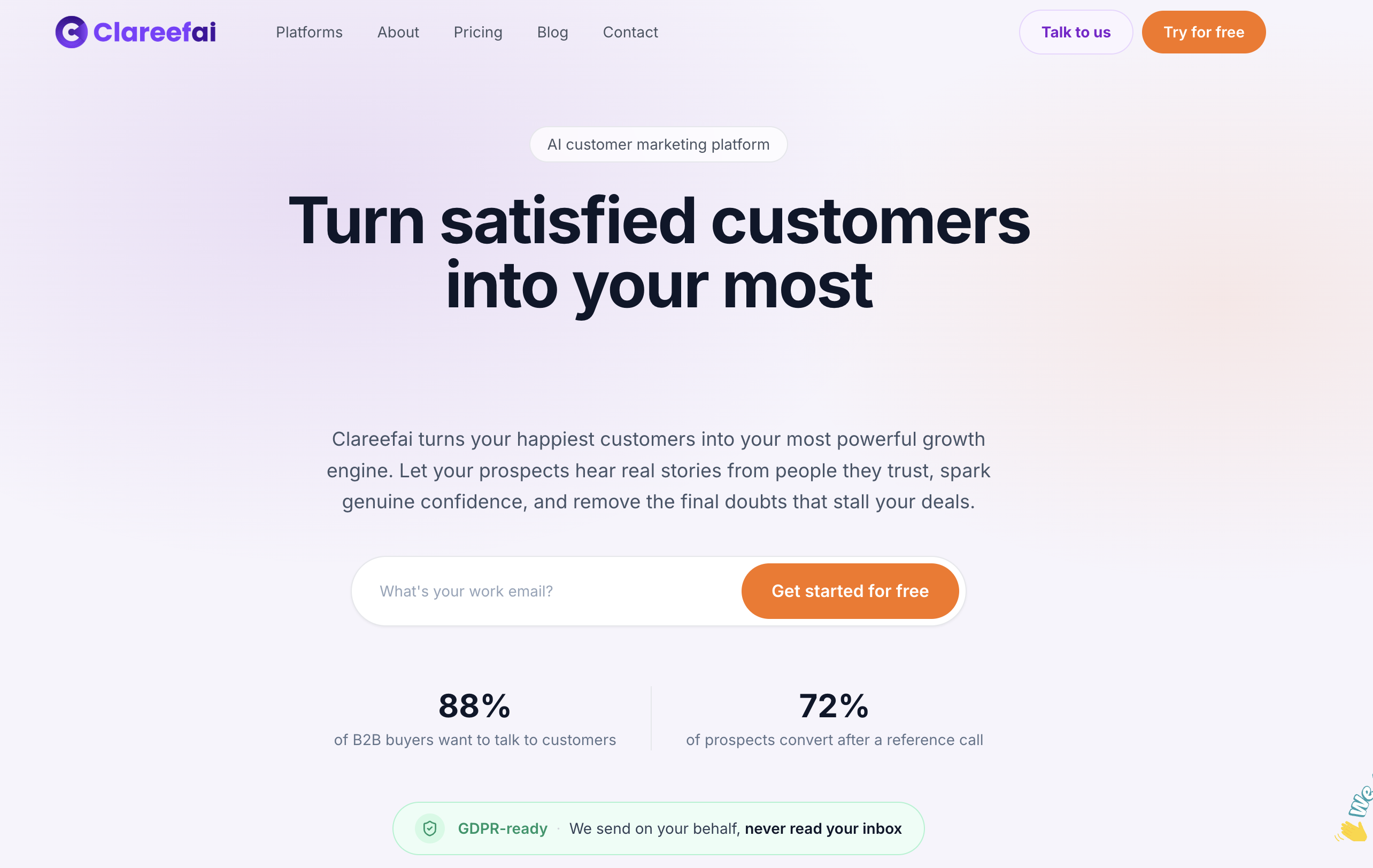
The platform syncs with your CRM for deal-stage and attribution tracking, so every completed reference call ties back to pipeline instead of disappearing into an anecdote. Role-based dashboards give sales, marketing, and management their own view into who’s being matched, how often, and what it’s driving, which matters when 92% of B2B buyers say testimonials and reviews influence purchase decisions. If you’re evaluating any platform for this job, use a short checklist: does it enforce fatigue caps automatically, sync bidirectionally with your CRM, verify advocate identity before matching, and show attribution back to revenue? Clareefai’s platform overview covers each of those points directly, and you can start a trial to see how a pilot segment performs before rolling it out company-wide.
Sources
- Exa
- Building a B2B Customer Reference Program That Closes Deals Faster — TalentBridge Blog
- Reference Customer Programs: Managing Customer Reference Requests - 2026 — Rework Resources
Recommended
Share Article
Stay Updated
Get the latest insights on customer advocacy and SaaS growth delivered to your inbox.