92% Trust Signal: Customer Advocates vs Influencers for Revenue
Customer advocates are unpaid, high-trust validators who convert and retain buyers; influencers are paid content creators who scale awareness. If your goal is pipeline or renewal revenue, prioritize advocacy. If your goal is market entry or brand reach, budget for influencers. Nielsen found that 92% of consumers trust recommendations from brand advocates, which is exactly why the two tactics solve different problems.
TL;DR:
- Advocacy programs are more cost-effective and deliver higher trust, with 92% of consumers trusting advocate recommendations compared to paid influencer content.
- Influencers are best suited for top-of-funnel brand awareness, while advocates are more reliable for mid- and bottom-funnel conversions and customer retention.
- Measurement should be separate: advocate ROI depends on referral rates and influenced revenue, whereas influencer ROI focuses on reach, engagement, and assisted conversions.
- Hybrid approaches that combine influencer reach with advocate validation outperform single-discipline efforts, especially in complex sales cycles.
- Effective scaling of advocacy relies on verified, AI-driven platforms that surface true advocates and track their impact across the full buyer journey.
Table of Contents
- Customer Advocates vs Influencers: A Side-by-Side Look
- Why the Distinction Matters More Than Marketers Assume
- When to Use Influencers vs Advocates in Your Funnel
- How to Find and Activate the Right Advocates and Influencers
- Measuring ROI: KPIs, Attribution, and Executive Reporting
- How an Advocacy Platform Turns Testimonials Into Sales Assets
- Where the Conventional Advice on Advocates and Influencers Falls Short
- Turn Verified Customers Into Your Fastest-Closing Sales Asset
- Where This Article’s Evidence Comes From
- Sources
Customer Advocates vs Influencers: A Side-by-Side Look
The two tactics diverge on almost every operational dimension except one: both influence buying decisions. Beyond that, they run on different fuel.
- Role and motivation: Advocates act out of loyalty and product satisfaction; influencers act because they’re compensated with cash, product, or affiliate fees.
- Funnel position: Influencers typically sit at the top, driving impressions and first touch. Advocates sit in the middle and bottom, closing consideration and reinforcing renewal decisions.
- Primary KPIs: Influencer campaigns track impressions, engagement rate, and click-through rate. Advocacy programs track referral rate, influenced revenue, and Net Promoter Score.
- Cost structure: Influencer partnerships carry direct media spend per post or campaign. Advocacy programs cost less in cash but require sustained internal effort to identify, verify, and activate promoters.
- Authenticity signal: Paid disclosure requirements mean audiences discount influencer claims somewhat. Advocate testimony carries no such asterisk.
The trust gap is the whole story here. Nielsen’s research puts advocate-driven trust at 92%, a number no paid channel can match because paid channels are, by definition, compensated speech.
Why the Distinction Matters More Than Marketers Assume
Confusing these two categories leads teams to measure advocacy programs against awareness metrics, or to expect influencers to close six-figure B2B deals. Neither comparison holds up.
The core difference is motivational, not just financial. An advocate recommends your product because it solved a real problem; an influencer promotes it because a brief and a fee say to. That distinction changes how reliable the outcome is. Zendesk notes that advocacy programs consistently link to retention, referrals, and revenue because advocates often double as beta testers, references, and community moderators, roles no influencer contract covers.
Overlap exists. A power user with 40,000 LinkedIn followers who genuinely loves your platform is both an advocate and an influencer, and that hybrid is often your strongest asset. What separates the two is whether the endorsement continues after the invoice or check clears.
- Advocates: motivated by outcomes, unpaid or lightly incentivized, high reliability over time.
- Influencers: motivated by compensation, contractually obligated, high reach but variable reliability.
- Hybrid advocates: rare, valuable, and worth a dedicated recruitment effort.
When to Use Influencers vs Advocates in Your Funnel
Match the tactic to the funnel stage, not the other way around.
- Use influencers for top-of-funnel awareness. They’re built for market entry, new-audience reach, and creative asset production at scale. Track impressions, engagement, and CTR to know if the spend is working.
- Use advocates for mid- and bottom-funnel conversion. Martech Zone frames advocates as validators who reduce buyer hesitation on complex, high-consideration purchases. Track referral rate, influenced revenue, Net Promoter Score, and customer lifetime value.
- Blend the two deliberately. Let an influencer campaign generate demand and top-of-funnel traffic, then hand qualified leads to advocate-driven proof (reviews, reference calls, case studies) to close the sale.
In practice, this looks like an influencer post driving 10,000 landing-page visits, while a testimonial carousel on that same page determines what percentage of those visitors actually request a demo. One insight from Martech Zone worth internalizing: unified programs that pair influencer reach with advocacy-driven conversion consistently outperform single-discipline campaigns, because advocacy preserves the conversion value that pure reach can’t generate on its own.
For B2B teams selling into long sales cycles, this split isn’t optional. A prospect who saw an influencer’s sponsored post six months ago rarely remembers it by the time they’re comparing vendors. The advocate reference call they had last week is what tips the decision.
How to Find and Activate the Right Advocates and Influencers
Recruitment looks different for each group, and treating them the same wastes effort on both sides.
- Mine your CRM for advocate signals. High usage frequency, strong NPS scores, unsolicited praise in support tickets, and existing public reviews all flag likely advocates before you ever ask them directly.
- Vet influencers on relevance before reach. Audience overlap with your buyer persona, real engagement rate (not just follower count), content quality, and any brand-safety red flags in past posts all matter more than raw numbers.
- Build an activation playbook. Invite advocates into reference-call rotations, UGC requests, or community moderator roles. Give influencers a creative brief with clear deliverables and disclosure requirements.
- Choose incentives carefully. Advocates often respond better to recognition, early product access, or community status than cash, which can undercut authenticity. Influencers expect market-rate compensation; treat that as a media buy, not a favor.
Pro Tip: Watch for the advocate who mentions your product unprompted in a public forum or review site. That person is usually more persuasive to a skeptical buyer than any paid post, because nobody asked them to say it.
Red flags to screen out on the influencer side include purchased followers, engagement pods, and any history of promoting direct competitors within the same buying cycle.

Measuring ROI: KPIs, Attribution, and Executive Reporting
Advocacy and influencer programs need separate scorecards, because judging one by the other’s metrics produces bad decisions.
- Advocate KPIs: referral conversion rate, influenced revenue, NPS trend, retention lift among referred customers.
- Influencer KPIs: reach, engagement rate, cost per engagement, assisted conversions within a defined attribution window.
- Attribution tactics: unique referral codes, dedicated landing pages per advocate or influencer, and a 30 to 90-day assisted-conversion window to catch delayed purchases.
- Influenced revenue calculation: tag deals touched by an advocate reference or influencer campaign in your CRM, then sum closed-won value within the attribution window.
Zendesk’s framing is useful here: advocacy is a lifecycle asset, not a campaign, so its ROI compounds over quarters rather than spiking and fading like a single influencer post. For executive reporting, one slide works best: influenced revenue, referral rate, NPS, and cost per acquired customer, side by side for each program.
How an Advocacy Platform Turns Testimonials Into Sales Assets
Scaling advocacy manually breaks down fast. Spreadsheets tracking who said what, when, and whether they’d consent to being quoted publicly don’t hold up past a few dozen customers.
Operationalizing advocacy at scale requires specific tooling: identity verification so testimonials can’t be dismissed as anonymous or fabricated, role-based dashboards so sales, marketing, and customer success see relevant advocates, and CRM integration so influence gets tracked across the full buyer journey. This is the exact gap platforms like Clareefai are built to close, using AI-driven analysis to surface which customers are most likely to convert as advocates and automatically routing their testimonials to the right sales or marketing channel.
Verified reference flows shorten sales cycles because prospects skip the step of wondering whether a testimonial is real. When identity and context are attached, skepticism drops and the deal moves faster.
Quick wins worth targeting: verify your top 10 promoters this quarter, connect testimonial data to your CRM, and give sales reps a searchable reference library instead of a folder of screenshots.
Where the Conventional Advice on Advocates and Influencers Falls Short
Most marketing content treats advocates and influencers as competing line items in the same budget, and that framing causes real damage. Teams either pour spend into influencer campaigns because the deliverables are easy to scope, or they treat advocacy as a nice-to-have testimonial page nobody actively manages.
Both mistakes come from the same root problem: influencer output is easy to measure early (a post went live, it got views), while advocacy value shows up later, in shorter sales cycles and higher renewal rates that are harder to trace back to a single source. That lag makes advocacy look weaker in a quarterly review even when it’s doing more work.
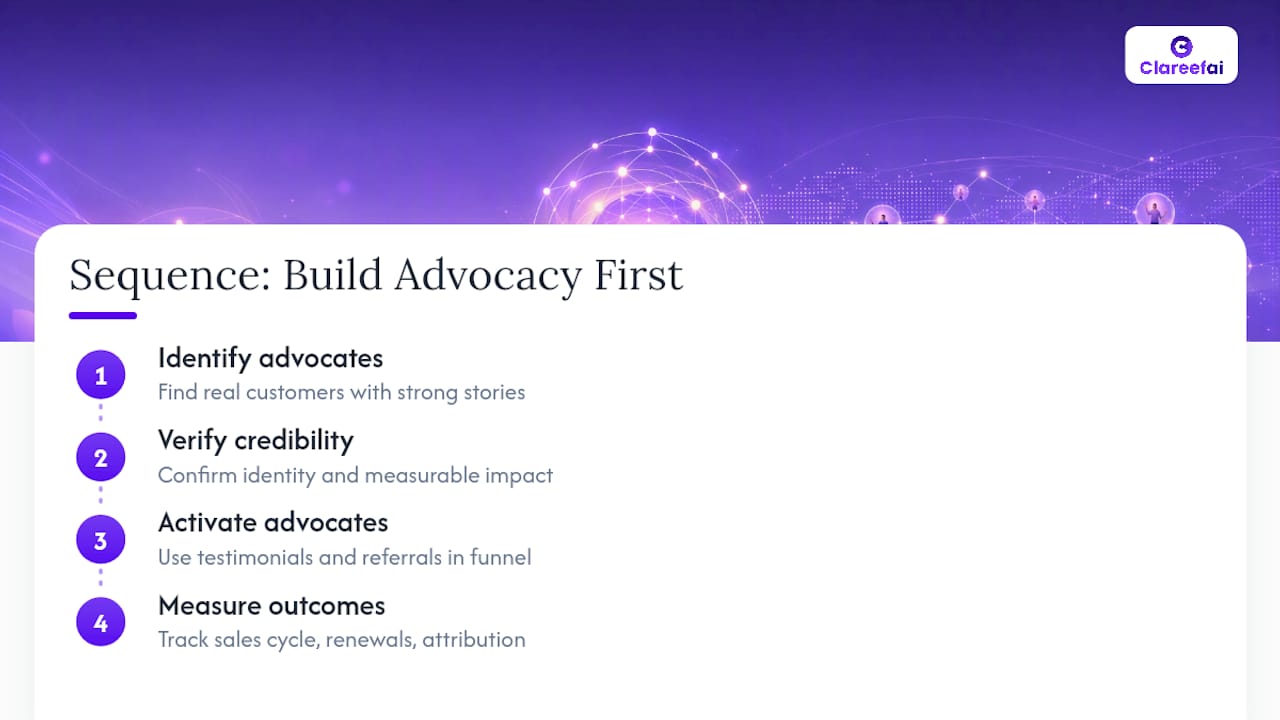
The fix isn’t choosing one tactic permanently. It’s sequencing them correctly and giving advocacy the same operational rigor you’d give a paid media program: identification, verification, activation, and measurement. Teams that skip verification end up with the same anonymous, generic-sounding testimonials that convinced no one in the first place. The reader’s real priority should be building the advocacy engine before scaling influencer spend, since advocacy is what determines whether that new top-of-funnel traffic actually closes.
— ClareefAi
Turn Verified Customers Into Your Fastest-Closing Sales Asset
Clareefai gives revenue teams what a spreadsheet full of screenshots never could: verified, searchable customer proof that sales can deploy at the exact moment a deal stalls. Instead of chasing testimonials manually or hoping a case study is still relevant, your team gets AI-identified promoters, role-based dashboards, and CRM-synced reference flows that shorten the path from “interested” to “signed.”
The platforms doing this well aren’t guessing which customers to feature. They’re using Clareefai’s platform to verify identity, surface the right advocate for each deal stage, and track influenced revenue without extra manual work. See how it plays out in a real win-rate case study, then start a trial to map your own promoters against your active pipeline this quarter.
Where This Article’s Evidence Comes From
Core sources: Nielsen on advocate trust, Zendesk on advocacy’s revenue link, Martech Zone on funnel roles, Wikipedia on program structure, and Babylovegrowth on social proof tactics.
Sources
- Trust in advertising: paid, owned and earned (Nielsen)
- Customer advocates and sales support (Zendesk)
- Influencers Vs. Advocates: Optimizing Reach, Trust, And Return On Investment | Martech Zone
- Customer advocacy — Wikipedia
Recommended
Share Article
Stay Updated
Get the latest insights on customer advocacy and SaaS growth delivered to your inbox.