What Is Customer Trust and Why It Drives Sales
TL;DR:
- Customer trust is a key factor that influences over 80% of purchase decisions and directly impacts revenue.
- Building trust involves demonstrating reliability, benevolence, transparency, and emotional connection through consistent actions and honest communication.
Customer trust is defined as the confidence customers place in a brand’s ability to deliver on its promises and meet their needs consistently. It is the foundation of every lasting customer relationship, and more than 80% of customers say trust directly influences their purchase decisions. That single statistic reframes trust from a soft concept into a hard revenue driver. For business professionals and decision-makers, understanding what customer trust means, and how to build it, is one of the most direct paths to improving sales performance and marketing effectiveness.
What is customer trust, and why does it matter for revenue?
Customer trust, in formal business terms, is often called perceived trustworthiness. It captures how reliably a brand performs, how honestly it communicates, and how genuinely it cares about customer outcomes. The customer trust definition goes beyond satisfaction. A customer can be satisfied with a single transaction and still not trust the brand enough to return.

The financial stakes are significant. 57% of business leaders see a direct, measurable link between consumer trust and revenue growth. When trust erodes, 73% of consumers spend less with that brand. These numbers confirm that trust is not a marketing abstraction. It is a measurable asset that shows up in your revenue line.
Acquiring a new customer costs 5 to 7 times more than retaining one. That cost gap makes trust a financial priority, not just a brand value. Every percentage point of retention you gain through stronger trust directly reduces your customer acquisition spend. For sales and marketing teams, that is a compelling reason to treat trust-building as a core function, not a secondary initiative.
What factors most significantly affect customer trust today?
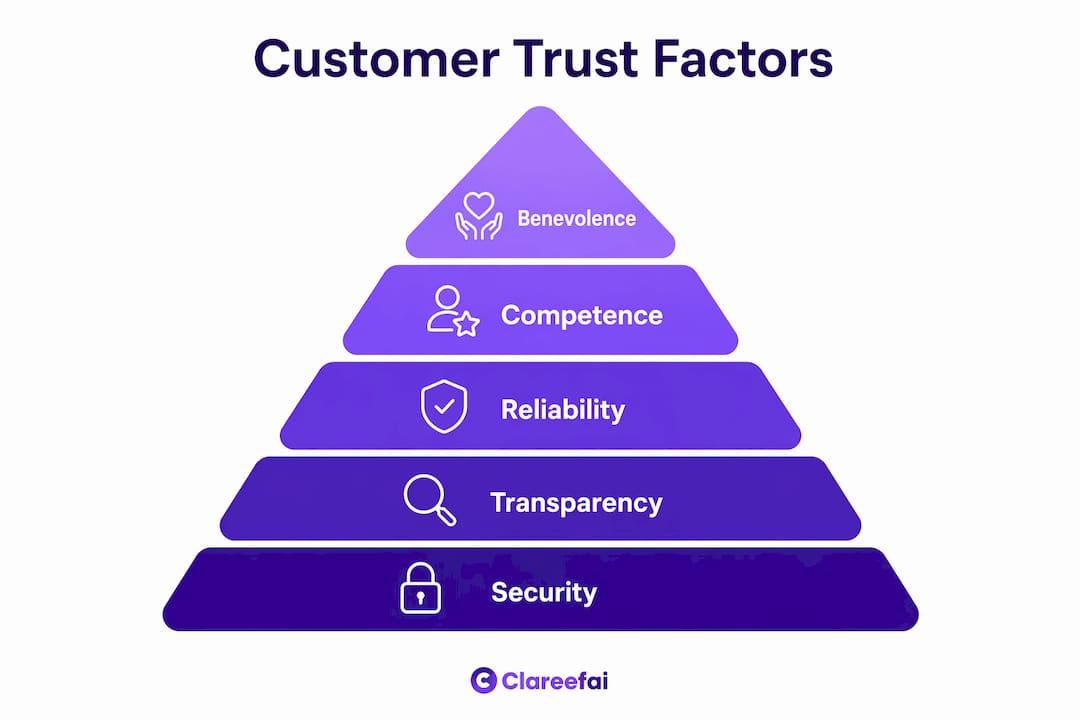
Customer trust is multidimensional. Research confirms it comprises five core dimensions: reliability, competence, benevolence, integrity, and predictability. Most companies invest heavily in demonstrating competence. Far fewer invest in benevolence, which signals genuine care for the customer’s outcome rather than just the transaction.
Benevolence is the differentiator for long-term relationships. A vendor who delivers a technically correct solution but shows no interest in the customer’s broader success will lose that customer to a competitor who does. Integrity, meaning consistent honesty even when it is inconvenient, builds the kind of credibility that survives mistakes.
Transparency has become a non-negotiable factor. Customers today expect brands to be open about limitations, pricing logic, and how personal data is used. 72% of consumers are hesitant to share personal data with companies they do not trust. That hesitancy directly limits your ability to personalize and improve the customer experience.
Emotional connection also plays a larger role than most leaders expect. How customers feel about a brand has 1.5 times more impact on loyalty than how they think about it. Rational evaluations matter, but emotional resonance drives the decision to stay, recommend, and expand.
Key factors that affect customer trust include:
- Reliability: Consistent delivery on every promise, large and small
- Benevolence: Visible care for customer outcomes beyond the sale
- Transparency: Honest communication about limitations, errors, and data use
- Data privacy: Clear, respectful handling of personal information
- Emotional connection: Interactions that feel human and genuinely attentive
Pro Tip: Map your customer touchpoints and identify where your brand signals benevolence versus where it only signals competence. The gap between those two lists is your trust-building opportunity.
How can businesses effectively build and maintain customer trust?
Building customer trust requires consistent behavior across every stage of the customer lifecycle, not just at the point of sale. The following practices move the needle most reliably.
-
Deliver on every promise, every time. Trust accumulates through repeated positive experiences. One broken promise can undo months of goodwill. Set realistic expectations and then exceed them, even in small ways.
-
Practice authentic accountability. Customers value owning mistakes and transparent communication about limitations far more than a flawless record. When something goes wrong, acknowledge it quickly, explain what happened, and show what you changed. This approach builds deeper confidence than pretending the error never occurred.
-
Use customer feedback as live intelligence. Responding transparently to negative feedback builds more trust than an error-free record. Publicly communicating service improvements based on customer input signals that you listen and act. That signal is powerful for prospects evaluating your brand.
-
Place trust signals at high-friction decision points. Verified testimonials, live metrics, and personalized social proof are most effective when placed where customers face the most doubt, such as pricing pages, checkout flows, and proposal reviews. Passive brand pages generate far less impact than contextually relevant proof at the moment of decision.
-
Explain data use at the moment of collection. Moving from data extraction to value exchange, by explaining exactly how data improves the customer’s experience, mitigates 79% of concerns about corporate data use. This single practice can significantly reduce friction in onboarding and account expansion.
-
Balance technology with human empathy. Automation speeds up service, but customers still want to feel heard by a person when it matters. Reserve human touchpoints for high-stakes moments: complaints, renewals, and upsell conversations.
Pro Tip: Integrate video testimonials from verified customers into your sales decks and proposal emails. Video creates emotional connection faster than written text and gives prospects a face to associate with your brand’s promise.
Authenticity in branding consistently outperforms polished perfection in building long-term customer relationships. Brands that show their process, admit their constraints, and celebrate their customers’ wins earn loyalty that advertising cannot buy.
What are the proven metrics to measure customer trust impact?
Measuring customer trust requires both quantitative indicators and qualitative signals. No single number captures the full picture, but the following metrics together give you a reliable view.
| Metric | What it measures | Trust signal |
|---|---|---|
| Net Promoter Score (NPS) | Likelihood to recommend | High NPS correlates directly with strong trust |
| Customer retention rate | Repeat purchase behavior | Sustained retention reflects consistent trust |
| Data-sharing consent rate | Willingness to share personal data | Low consent signals trust erosion |
| Emotional connection survey | Feeling valued vs. just served | Captures benevolence and integrity perception |
| Testimonial and review volume | Unprompted advocacy | Active promoters indicate high trust levels |
NPS is the most widely used trust proxy. It measures customers’ willingness to put their own reputation on the line by recommending you. That willingness is a direct expression of trust. A declining NPS score is one of the earliest warnings of a trust gap forming.
Customer retention rates tell you whether trust is holding over time. A customer who renews, expands, or upgrades is voting with their wallet. Tracking retention by cohort, especially after service incidents, reveals how well your recovery behaviors rebuild confidence.
Customer feedback operationalized as a growth tool can also surface trust signals that quantitative metrics miss. Sentiment patterns in support tickets, review language, and churn surveys often reveal the emotional drivers behind trust erosion before they show up in revenue data.
What common challenges and misconceptions hinder building sustainable customer trust?
Several widely held beliefs about customer trust actively work against the goal of building it.
-
Misconception: Customers want perfection. They do not. They want accountability. A brand that handles a failure with honesty and speed earns more trust than one that never visibly fails. The expectation of flawlessness creates a culture of concealment, which destroys trust faster than any mistake.
-
Misconception: Competence is enough. Competence is the entry ticket, not the differentiator. Benevolence, the visible demonstration that you care about the customer’s outcome, is what separates trusted brands from merely adequate ones.
-
Underestimating emotional intelligence. Leaders who manage trust purely through SLAs and satisfaction scores miss the emotional layer entirely. Customers who feel respected and understood stay longer and spend more, even when the product is not the cheapest option.
-
Trust gaps from misaligned promises. Misaligned marketing promises and actual customer experience create trust gaps that are difficult to repair. Overpromising in sales materials and underdelivering in onboarding is one of the fastest ways to destroy early-stage trust.
-
Data privacy missteps. Collecting data without clear explanation triggers distrust immediately. Customers notice when personalization feels intrusive rather than helpful.
“Trust is not a static achievement. It is a dynamic asset that requires active maintenance, honest communication, and consistent delivery. The moment a business treats trust as a one-time campaign rather than an ongoing operational commitment, it begins to lose it.”
The most overlooked challenge is the dynamic nature of trust itself. It does not stay at the level you built it to. Competitive pressure, market changes, and individual customer experiences all shift it continuously. Leaders who measure trust quarterly and adapt their behaviors accordingly protect their revenue base far more effectively than those who assume trust is stable.
Key Takeaways
Customer trust is the single most durable competitive advantage a business can build, and it requires consistent behavior across reliability, transparency, benevolence, and data integrity.
| Point | Details |
|---|---|
| Trust drives purchase decisions | More than 80% of customers say trust directly influences whether they buy. |
| Benevolence differentiates brands | Demonstrating genuine care for customer outcomes builds loyalty beyond competence alone. |
| Authentic accountability builds credibility | Owning mistakes transparently earns deeper trust than a flawless record. |
| Place trust signals strategically | Verified testimonials and social proof work best at high-friction decision points. |
| Measure trust continuously | NPS, retention rates, and data-sharing consent together reveal trust health over time. |
Why I believe trust is the most underused growth lever in B2B
Most B2B leaders treat customer trust as a byproduct of good service. I think that framing is the core mistake. Trust is not what happens after you deliver well. It is the operating condition that makes customers willing to give you the chance to deliver at all.
The shift I see making the biggest difference is moving from transactional relationships to emotional ones. That does not mean being less professional. It means being more human. It means your sales team shares real customer stories, not polished case studies. It means your support team owns problems instead of escalating them. It means your marketing shows the people behind the product, not just the product itself.
The brands that build durable trust treat it as an organizational discipline, not a marketing campaign. They align leadership, operations, and customer-facing teams around a shared set of behaviors. They measure trust the same way they measure revenue. They respond to trust erosion signals the same way they respond to churn signals.
The B2B trust-building strategies that move the needle are not complicated. They are consistent. Consistency, over time, is what trust actually is.
— ClareefAi
How Clareefai helps you turn customer trust into sales results
Customer trust is only as powerful as your ability to demonstrate it to prospects at the right moment. Clareefai gives sales and marketing teams a centralized platform to collect, verify, and deploy customer testimonials, reviews, and success stories exactly where prospects need them most.
With AI-driven analysis, Clareefai identifies your most credible customer advocates and surfaces their stories automatically across your sales channels. Every testimonial is identity-verified and contextualized, so prospects see real outcomes from real customers, not anonymous praise. The result is faster decision-making, shorter sales cycles, and higher close rates. If you are ready to put your customers’ trust to work, explore Clareefai’s sales solutions and see how verified social proof changes the conversation.
FAQ
What is the customer trust definition in business?
Customer trust is the confidence customers have that a brand will consistently deliver on its promises and act in their best interest. It encompasses reliability, integrity, benevolence, and transparency across every interaction.
Why is customer trust important for sales teams?
Trust directly influences more than 80% of purchase decisions, and losing it causes 73% of consumers to reduce their spending. Sales teams that deploy verified social proof at key decision points close deals faster and retain customers longer.
How do you measure customer trust effectively?
Net Promoter Score, customer retention rate, data-sharing consent rate, and emotional connection surveys together provide a reliable view of trust health. Declining NPS is typically the earliest quantitative signal of a trust gap.
What are the most effective ways to enhance customer trust?
Authentic accountability, transparent data practices, consistent promise delivery, and placing verified testimonials at high-friction decision points are the most proven methods. Responding publicly to negative feedback also builds credibility faster than an error-free record.
How does customer loyalty and trust relate to revenue growth?
57% of business leaders confirm a direct, measurable link between consumer trust and revenue growth. Loyal customers who trust a brand spend more, churn less, and actively refer new customers, compounding revenue without additional acquisition cost.
Recommended
- How Customer Testimonials Build Trust and Differentiate Your SaaS Brand | ClareefAI Blog
- B2B Trust Education Guide for Sales and Marketing Teams | Clareefai Blog
- Improving B2B Trust Process: A 2026 Guide for Sales Teams | Clareefai Blog
- Multi-Channel Social Proof: Maximizing B2B Trust | ClareefAI Blog
Share Article
Stay Updated
Get the latest insights on customer advocacy and SaaS growth delivered to your inbox.