The B2B Customer Advocacy Process Guide for 2026
The most effective customer advocacy process for 2025 follows six stages: Identify → Recruit → Enable → Activate/Amplify → Measure → Scale. Run this process well and you’ll see shorter sales cycles, lower customer acquisition costs, and stronger net retention, because verified peer voices close deals that branded content cannot.
For 2025 specifically, three elements separate programs that move the needle from those that stall:
- AI-powered signal detection to surface your best advocates before they go cold
- Privacy-first consent workflows that comply with CCPA and GDPR from day one
- Cross-functional governance that keeps CS, marketing, and sales aligned on who asks for what and when
Key Takeaways
A well-governed, six-stage advocacy process, built on AI signal detection, privacy-first consent, and cross-functional alignment, is the most reliable way to convert satisfied customers into measurable revenue influence in 2025.
| Point | Details |
|---|---|
| Six-stage process | Follow Identify → Recruit → Enable → Activate/Amplify → Measure → Scale for a repeatable program. |
| Pilot before you buy | Start with 10–20 founding advocates and manual workflows before investing in a platform. |
| Consent is non-negotiable | Capture written consent before publishing any quote, video, or case study to stay CCPA and GDPR compliant. |
| Measure revenue influence | Tag advocacy touchpoints in your CRM and report influenced pipeline quarterly to protect your budget. |
| Clareefai operationalizes the process | Clareefai automates advocate identification, consent capture, and multi-channel publishing with built-in ROI dashboards. |
Table of Contents
- Why the customer advocacy process looks different in 2026
- A staged process model mapped to the Forrester Customer Advocacy Model
- What to do at each stage: a practical checklist
- The operational backbone: governance, workflows, and integrations
- How to measure advocacy: KPIs and revenue attribution
- Common mistakes and how to fix them
- Pilot timeline and realistic cost ranges for U.S. teams
- What a modern advocacy platform must do
- What running B2B advocacy programs actually teaches you
- Clareefai puts the advocacy process to work for your team
- Sources
Why the customer advocacy process looks different in 2026
Four converging forces are reshaping how B2B teams need to design their advocacy programs this year.
Peer validation now dominates buyer journeys. Academic research published in Frontiers in Communication confirms that peer narratives carry stronger persuasive power than branded content in many decision contexts. Your prospects trust a verified customer story more than your best-written case study, and that gap is widening as buyers grow more skeptical of polished marketing.
Vendor switching is faster and cheaper than ever. SaaS buyers can migrate to a competitor in weeks. Advocacy programs reduce churn by deepening relationships with your most engaged accounts and giving them a reason to stay invested in your success. Harvard Business Review research shows that improved customer experience links directly to higher revenue and retention, which means every advocate you develop is also a retention signal worth tracking.
AI and automation raise both the opportunity and the governance bar. You can now detect NPS promoters, product power users, and expansion signals automatically. The risk is that automation without human oversight produces low-quality asks at the wrong moment, burning advocate goodwill fast.
Privacy regulations require explicit consent. CCPA in California and GDPR practices adopted by many U.S. enterprise buyers mean you need a documented consent workflow before you publish any customer story, quote, or video. Programs that skip this step face legal exposure and, more practically, lose advocate trust when something goes live without proper approval.
“Programs that are proactive, measurable, and flexible consistently outperform reactive, ad hoc efforts.” — Forrester Customer Advocacy Model
A staged process model mapped to the Forrester Customer Advocacy Model
Forrester’s Customer Advocacy Model frames advocacy as a structured, repeatable discipline, not a one-off campaign. The six-stage process below maps directly to that framework and gives each stage a clear owner and expected output.

| Stage | Primary Owner | Key Inputs | Expected Output |
|---|---|---|---|
| Identify | Customer Success | NPS scores, product usage data, renewal signals | Qualified advocate shortlist |
| Recruit | CS + Customer Marketing | Milestone triggers, personalized outreach | Signed advocate agreements with consent |
| Enable | Customer Marketing | Advocacy toolkit, talking points, legal-approved templates | Advocate-ready with assets in hand |
| Activate/Amplify | Marketing + Sales | Reference requests, review asks, content briefs | Published testimonials, references fulfilled |
| Measure | Marketing Ops + CS | CRM data, attribution reports, engagement metrics | ROI dashboard, advocacy KPI scorecard |
| Scale | Program Owner | Pilot learnings, governance docs, tech stack | Repeatable program serving 50+ advocates |
AdvocacyMaven’s 10-step scalable framework reinforces a critical sequencing point: build your process before you buy your platform. Teams that invest in tooling before their workflows are stable waste budget and confuse advocates. Start with a pilot of 10–20 accounts, learn what works, then layer in automation.
The Rework customer advocacy fundamentals guide adds a useful tiering lens: not every advocate participates the same way. A silver-tier advocate might share a LinkedIn post; a gold-tier advocate records a video testimonial; a VIP advocate joins your advisory board or speaks at your event. Designing participation tiers from the start prevents over-asking your most engaged customers.
What to do at each stage: a practical checklist
This is where strategy becomes execution. Each stage below names the owner, the timing, and the specific deliverable.
Stage 1: Identify
Owner: Customer Success Manager
Timing: Ongoing, triggered by NPS response, renewal milestone, or expansion event
Actions:
- Pull NPS promoters (score 9–10) from your survey platform weekly
- Flag accounts with high product adoption and low support ticket volume
- Cross-reference with accounts that have expanded MRR in the last 90 days
- Score and rank candidates by relationship strength and story quality
Stage 2: Recruit
Owner: CS + Customer Marketing
Timing: Within two weeks of a positive signal (post-renewal, post-go-live, post-expansion)
Actions:
- Send a personalized, low-friction ask tied to a specific milestone (“You just hit X outcome — would you be open to sharing that story?”)
- Offer a clear menu of participation options so the advocate chooses their comfort level
- Capture explicit consent at this stage, documented in your CRM
- Use a step-by-step testimonial workflow to standardize the intake process
Pro Tip: *Ask at the moment of value, not the moment of convenience.
Stage 3: Enable
Owner: Customer Marketing
Timing: Immediately after recruitment confirmation
Actions:
- Deliver an advocacy toolkit: approved talking points, social sharing cards, reference call prep sheet, and a one-page FAQ on what participation involves
- Brief the advocate on what to expect (timeline, ask frequency, approval process)
- Set expectations on how often you’ll reach out (monthly maximum for most advocates)
Stage 4: Activate and Amplify
Owner: Marketing + Sales
Timing: Ongoing, coordinated through a central request queue
Actions:
- Route reference call requests through a single intake form so no advocate gets double-booked
- Request G2, Capterra, or Google reviews with a direct link and a one-sentence context note
- Brief video testimonials: send a three-question guide, offer a recorded Zoom option, and handle editing yourself
- Repurpose one high-quality conversation into multiple assets: a written quote, a short video clip, a case study snippet, and a social post. HubSpot’s advocacy marketing playbook calls this the highest-yield move in any advocacy program
- Invite top advocates to speak at webinars or co-author a blog post for additional amplification
Stage 5: Measure
Owner: Marketing Ops
Timing: Monthly reporting, quarterly business review inclusion
Actions:
- Track advocacy conversion rate, references fulfilled, referral revenue influenced, and Time-to-first-reference
- Report advocate utilization (what percentage of your roster was activated in the last 30 days)
- Connect advocacy activity to pipeline in your CRM using a custom field or campaign tag
Stage 6: Scale
Owner: Program Owner (dedicated or shared)
Timing: Month 9 onward, after pilot validation
Actions:
- Document every workflow, SLA, and approval checkpoint from the pilot
- Expand the advocate roster using the same qualification criteria that worked in the pilot
- Introduce automation for signal detection and consent capture
- Present a quarterly advocacy impact report to leadership to maintain cross-functional buy-in
The operational backbone: governance, workflows, and integrations
A great process on paper fails without the infrastructure to run it. Here’s what the operational backbone needs to include.
Governance structure:
- A named program owner allocated for the pilot phase
- A stakeholder committee with representatives from CS, marketing, and sales who meet monthly
- A documented intake process for advocacy requests with a 48-hour SLA for urgent reference calls
- An escalation path when an advocate is over-requested
Core workflows to document:
- Nomination → qualification → onboarding → request fulfillment → appreciation → tracking
- Each step needs a named owner, a tool or system of record, and a completion trigger
Content enablement and legal checkpoints:
- Every published asset (quote, video, case study) requires written consent captured before publication
- Legal review for any asset that includes financial claims, performance metrics, or competitive comparisons
- Accessible publishing standards matter too: W3C WCAG 2.1 AA conformance should guide how you publish video testimonials and written stories to ensure they reach all audiences
Integration requirements:
- CRM fields for advocate status, last request date, consent status, and participation tier
- NPS/CX survey hooks that automatically flag promoters for CS follow-up
- Product analytics integration to surface power users who haven’t yet been recruited
- Community platform connections for peer-to-peer amplification
Governance readiness checklist:
- [ ] Program owner named and allocated
- [ ] Stakeholder committee formed with meeting cadence set
- [ ] Intake form live and routed to program owner
- [ ] Consent workflow documented and tested
- [ ] CRM fields created and mapped
- [ ] Advocacy toolkit approved by legal and marketing
Segment8’s advocacy program playbook makes a point worth internalizing: satisfied customers don’t automatically become advocates. The gap between “happy customer” and “active promoter” is closed by structure, not by goodwill alone.
How to measure advocacy: KPIs and revenue attribution
Advocacy programs that can’t show revenue influence don’t survive budget cycles. Build your measurement framework around two tiers.
Primary KPIs (report monthly):
- Advocacy conversion rate: percentage of NPS promoters who become active advocates
- References fulfilled: number of reference calls completed per quarter
- Referral revenue influenced: pipeline value where an advocate reference or testimonial was part of the deal
- Time-to-first-reference: days from advocate onboarding to first fulfilled request (target: under 30 days)
- Advocate utilization rate: percentage of your roster activated in the last 30 days
Secondary KPIs (report quarterly):
- NPS promoter-to-advocate conversion rate
- Review count and average rating on key platforms (G2, Capterra, Google)
- Content reach: impressions and engagement on published advocate assets
- Pledge-to-fulfill rate: how often a committed advocate actually completes the ask
Revenue attribution approach:
Tag every deal in your CRM where an advocacy touchpoint occurred (reference call, testimonial viewed, case study shared). At quarter-end, sum the closed-won pipeline value from tagged deals. This gives you an advocacy-influenced revenue figure without requiring multi-touch attribution software.
A simple ROI frame: compare the cost of your advocacy program (people + tools) against the advocacy-influenced pipeline and the estimated retention value of your active advocate accounts. HBR’s research on customer experience value provides the empirical foundation for connecting CX investment to revenue outcomes.
For management dashboards, the Clareefai management dashboard surfaces these metrics in real time, giving leadership visibility into advocacy ROI without manual reporting.
Dashboard fields to include:
- Active advocate count by tier
- Requests open vs. fulfilled (last 30 days)
- Referral pipeline influenced (quarter-to-date)
- Top advocates by activity
- Consent status by account
Common mistakes and how to fix them
Most advocacy programs fail for predictable reasons. Knowing the patterns lets you course-correct before they cost you advocates or budget.
| Mistake | Fix |
|---|---|
| Treating advocacy like a campaign with a start and end date | Build a permanent program with quarterly planning cycles, not one-off pushes |
| Over-asking your top 5 advocates for everything | Distribute requests across your full roster; cap asks per advocate at 2 per month |
| No cross-functional buy-in from sales | Include sales in the stakeholder committee; show them reference call win-rate data |
| No consent or approval controls | Implement a documented consent workflow before publishing any asset |
| Tracking activity but not revenue influence | Add CRM tagging for advocacy touchpoints and report influenced pipeline quarterly |
Red flags to watch in program health:
- Advocate response rate dropping below 40% (over-ask signal)
- More than 60 days since any new advocate was recruited (pipeline drying up)
- Reference requests being fulfilled by the same 3–4 advocates repeatedly
- No legal review checkpoint in your content approval process
- Advocates reporting they didn’t approve a published quote (consent failure)
When you see these signals, pause new requests, audit your ask frequency, and reconnect with your advocate roster personally before resuming. Customer retention strategies that emphasize relationship depth over transactional asks apply directly here: advocates who feel valued stay active; those who feel used go quiet.
Pilot timeline and realistic cost ranges for U.S. teams
Phase 1: Pilot (months 0–3)
- Recruit 10–20 founding advocates manually, no platform required
- Test your recruitment messaging, consent workflow, and fulfillment process
- Deliver your first 5–10 reference calls and 3–5 published testimonials
- Staffing: 0.5 FTE advocacy owner, shared CS and marketing support
- Cost range: primarily people time; light tooling (survey platform, CRM fields) adds minimal incremental cost
Phase 2: Operationalize (months 3–9)
- Document all workflows from the pilot
- Introduce a purpose-built advocacy platform or expand CRM automation
- Grow the roster to 30–50 advocates
- Staffing: 1 FTE advocacy owner, dedicated customer marketing support
- Platform cost: light-to-mid-tier SaaS advocacy tools in the U.S. market typically run in the range of a few hundred to a few thousand dollars per month depending on roster size and features
Phase 3: Scale (months 9–18)
- Expand to 50+ advocates across multiple segments or product lines
- Integrate advocacy data into your revenue reporting and QBR cadence
- Introduce tiered participation tracks and an advocate community or portal
- Staffing: 1–1.5 FTE plus cross-functional support from CS, marketing, and sales
Expect measurable pipeline influence to appear after some months, once you have enough fulfilled references and published assets to tag in closed-won deals. AdvocacyMaven’s framework consistently recommends delaying heavy platform investment until your process is stable, which this phasing reflects.
What a modern advocacy platform must do
Technology should reduce friction, not create it. When evaluating platforms, check for these capabilities.
Must-have features:
- Automated advocate identification using AI signals (NPS, product usage, expansion data)
- Consent capture with a documented audit trail for every published asset
- Centralized asset management for testimonials, video clips, case studies, and reference profiles
- Multi-format publishing to your website, CRM, sales enablement tools, and review platforms
- CRM integration (Salesforce, HubSpot) with bi-directional sync
- Analytics and attribution dashboards that connect advocacy activity to pipeline
Security and compliance checklist:
- GDPR-compliant data handling with documented data processing agreements
- CCPA-ready consent workflows for U.S. customer data
- Customer identity verification to prevent anonymous or fabricated reviews
- SOC 2 attestation or equivalent controls (ask vendors to share their AICPA SOC report or equivalent documentation)
- Accessible publishing: video testimonials should meet WCAG 2.1 AA standards for captions and contrast
Integration checklist:
- CRM: Salesforce, HubSpot, or equivalent
- Survey platforms: Medallia, Qualtrics, or Delighted for NPS hooks
- Product analytics: Mixpanel, Amplitude, or Pendo for usage signals
- Content management and sales enablement: Highspot, Seismic, or equivalent
- Review platforms: G2, Capterra, Trustpilot
Clareefai as an operational example: Clareefai’s platform implements AI-driven promoter identification that surfaces your best advocate candidates automatically, verified testimonial collection that replaces anonymous reviews with identity-confirmed stories, and one-click publishing to your sales and marketing channels. Its dashboards give CS, marketing, and management teams separate views of advocacy activity and ROI, and its GDPR-compliant workflows handle consent capture and audit trails natively. For marketing teams specifically, the platform converts collected testimonials into demand-generation assets without manual reformatting.
What running B2B advocacy programs actually teaches you
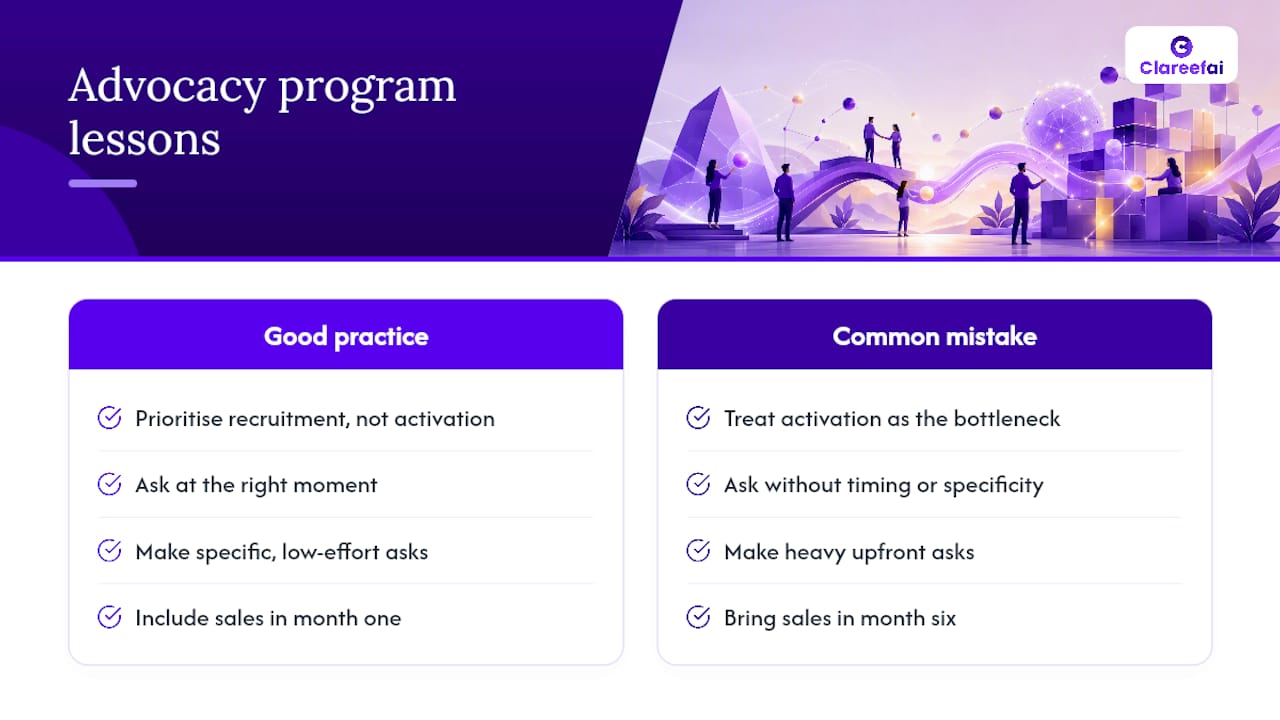
The sequencing lesson that surprises most teams: recruitment is harder than activation. Getting a customer to say yes is the bottleneck, not getting them to record a video or take a reference call. The teams that solve recruitment first, by asking at the right moment with a specific, low-effort ask, build rosters that stay active for years.
Cross-functional wins tend to appear earlier than expected when sales is included from the start. When a sales rep sees a reference call close a deal, they become your best internal advocate for the program. That internal advocacy is what gets you budget, headcount, and executive attention. Bring sales into your stakeholder committee in month one, not month six.
The hardest thing to preserve at scale is personalization. When your roster grows from 15 to 75 advocates, the temptation is to automate every touchpoint. Resist it. A personal check-in from the program owner, even a short email with no ask attached, does more for long-term advocate engagement than any automated nurture sequence. The advocates who stay most active are the ones who feel like partners, not resources.
Clareefai puts the advocacy process to work for your team
Most advocacy programs stall not because of strategy gaps but because the operational work is too manual. Collecting consent, matching the right advocate to the right prospect, publishing a testimonial to five different channels, and tracking which reference calls influenced a deal, all of that takes hours per week when done by hand.
Clareefai is built to handle that operational load so your team can focus on relationships. Its AI identifies your strongest advocate candidates from NPS, usage, and expansion signals before you even think to look. Verified testimonials replace anonymous reviews with identity-confirmed stories that prospects actually trust. One-click publishing sends approved content to your CRM, your website, and your sales enablement tools simultaneously. And its unified testimonial management connects directly to win-rate reporting so you can show leadership exactly what advocacy is worth. Request a demo at Clareefai and see how the platform maps to your current stage.
Sources
- Introducing The Forrester Customer Advocacy Model |
- 10 Steps to Build a Scalable Customer Advocacy Program
- The value of customer experience, quantified
- Peer narratives and the persuasive power of authentic customer stories
Recommended
Share Article
Stay Updated
Get the latest insights on customer advocacy and SaaS growth delivered to your inbox.