Video Testimonial Length for Marketers: Shoot Once, Publish Every Cut
Aim for a 60 to 90 second anchor testimonial, then cut shorter versions for ads and social feeds. That runtime gives you enough room for a real customer story with a specific result, without losing the viewer before you get there. The exact number still shifts by placement and funnel stage, but 60 to 90 seconds is the default worth building your shoot around.
TL;DR:
- Shorter testimonial cuts of 15 to 30 seconds perform best in paid ads and social feeds, where viewers have limited attention spans.
- The ideal range for most testimonial videos is 60 to 90 seconds, as longer formats risk losing engagement while shorter ones may lack sufficient proof.
- Longer videos of 3 to 5 minutes suit enterprise and high-consideration audiences, who seek deeper insights and detailed results.
- Testing different lengths consistently across channels helps identify the most effective duration for your audience and placement.
- Planning interview prompts and shooting time around specific target lengths enables efficient production of multiple cuts from one session.
Table of Contents
- How Long Should a Testimonial Be for Each Channel?
- Should Your Testimonial Be Short or Long?
- How Do You Script and Shoot a Tighter Testimonial?
- How Do You Test the Right Testimonial Length for Your Audience?
- How Do You Get Multiple Testimonial Lengths From One Shoot?
- What’s the Bottom Line on Testimonial Length?
- What Changes at Enterprise Scale?
- Turn One Good Interview Into Every Length You Need
- Sources
- FAQ
How Long Should a Testimonial Be for Each Channel?
There’s no single right answer to “how long should a testimonial be,” because the honest answer depends entirely on where it’s going to run. A landing page visitor who just clicked “customer stories” has a different attention budget than someone scrolling LinkedIn during a commute. Match the length to the context, and you’ll waste a lot less footage on cuts nobody watches to the end.
Here’s how the ranges break down by placement, based on practitioner guides that track performance across formats:
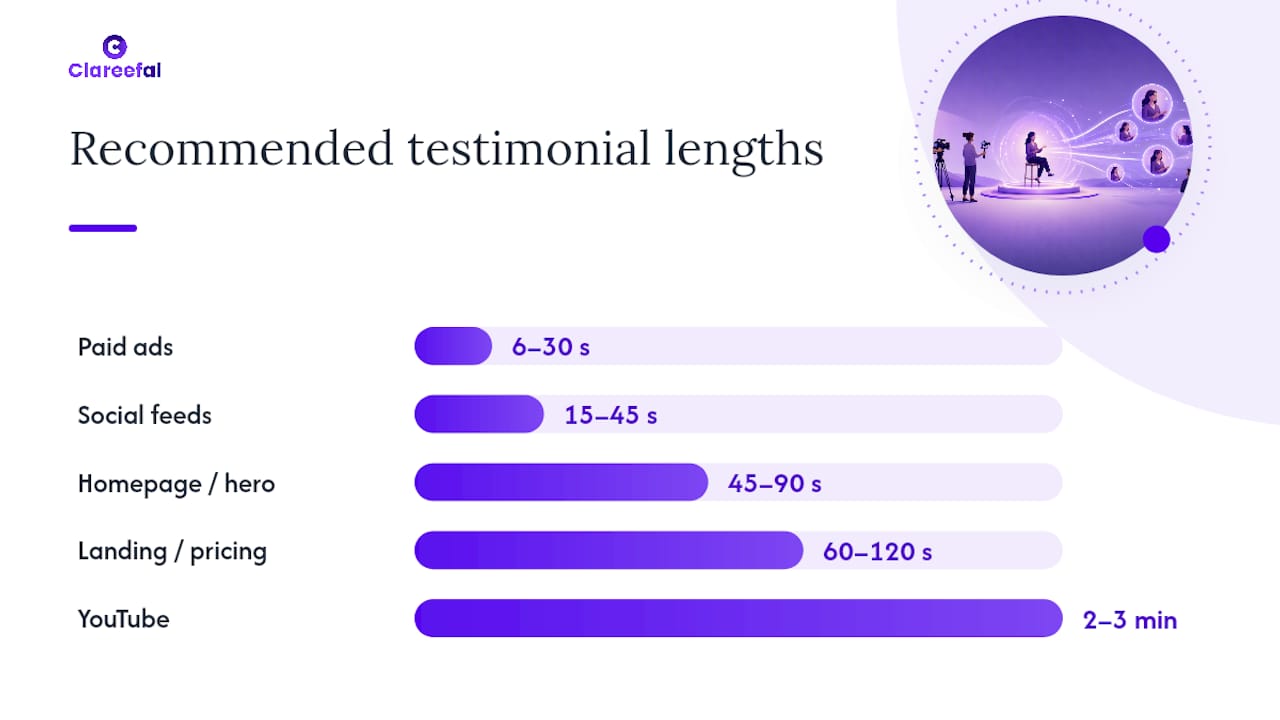
- Paid ads (6 to 30 seconds): You have almost no runway. Lead with the result, not the setup.
- Social feeds (15 to 45 seconds): Assume silent autoplay and a thumb that’s already moving.
- Homepage or hero section (45 to 90 seconds): Visitors are curious but not committed yet. Give them a quick story arc.
- Landing and pricing pages (60 to 120 seconds): These viewers are closer to a decision, so a bit more proof earns its runtime.
- LinkedIn for B2B (60 to 120 seconds): Professional audiences will sit through more context if the speaker’s title and problem are credible fast, making tools like the LinkedIn Ad Generator valuable for formatting short paid creatives.
- YouTube (2 to 3 minutes): Viewers arrived intentionally, often through search, so they’ll tolerate a fuller narrative.
- Long-form case study video (3 to 5 minutes): Reserved for high-consideration, multi-stakeholder purchases where depth is the point.
These ranges track closely with what Storimatic Studio’s testimonial length guide recommends across placements, and they line up with Wistia’s research on optimal video length, which found that engagement drops sharply once a video crosses the two-minute mark for most conversion-focused content.
Regardless of runtime, every cut needs to hit four beats: a hook, proof of the problem being real, a specific result, and a clear next step. A 15 second ad cutdown might compress all four into single sentences. A 3 minute case study can slow down and let the customer breathe between them, but skipping any one of the four is what turns a testimonial into background noise.
Production details matter as much as timing. Vertical 9:16 framing is non-negotiable for Stories and Reels, while 16:9 still serves homepage and YouTube placements best. Captions aren’t optional anywhere, since most social video plays muted by default. And your first frame functions as a thumbnail whether you designed it that way or not, so frame the customer clearly and avoid opening on a blank slate or a slow zoom.
Should Your Testimonial Be Short or Long?
The decision isn’t about personal preference. It’s about where the viewer sits in your funnel and how much patience that position buys you.
Cold traffic, meaning people who’ve never heard of your company, will abandon video fast if it doesn’t reward them immediately. HubSpot’s video marketing research consistently shows steep early dropoff on unfamiliar content, and testimonial guides put the real danger zone in the first 5 to 10 seconds. If your customer’s name and title take 8 seconds to appear before they say anything useful, you’ve likely lost a meaningful chunk of the audience already.
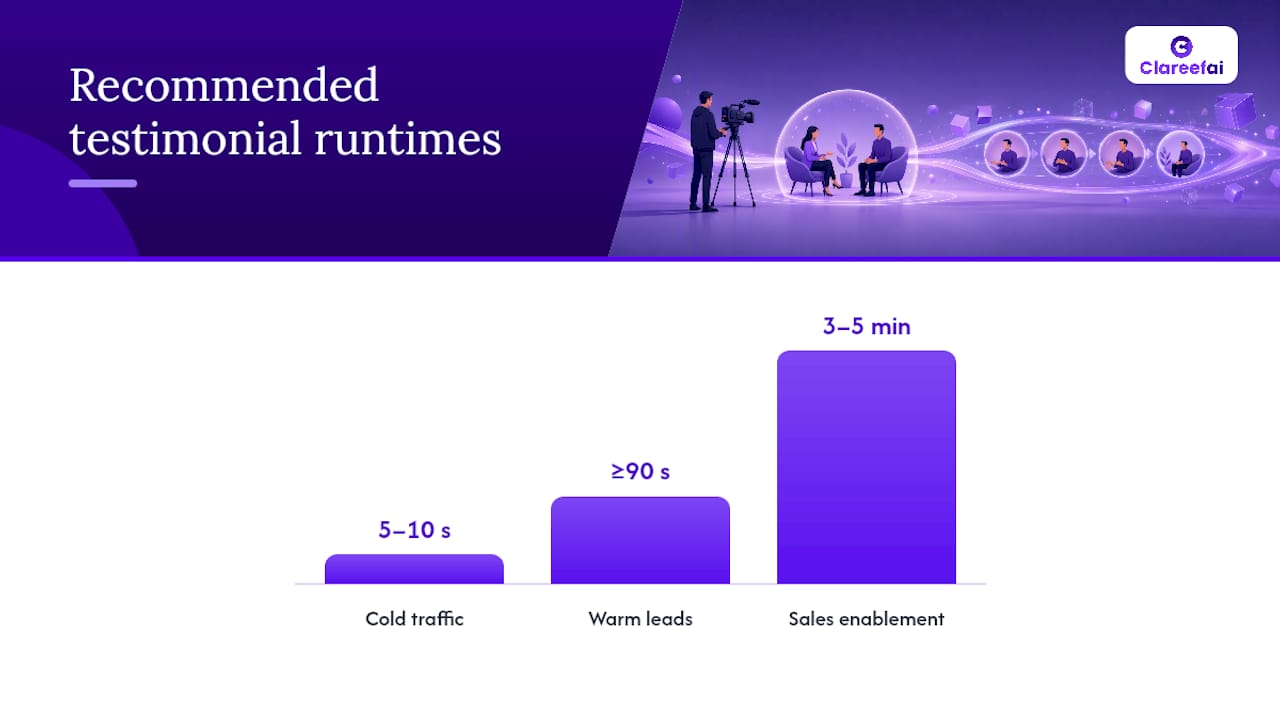
Warm leads and buyers in active evaluation behave differently. Someone who requested a demo or is comparing vendors will sit through 90 seconds or more, because they’re actively looking for reasons to trust you. This is where longer testimonials, including full case-study formats, earn their place. Save the 3 to 5 minute cuts for sales enablement, not cold social ads.
Long testimonials fail for predictable reasons. The most common: no clear result stated anywhere in the video, a rambling structure with no obvious beginning or end, and a CTA that either doesn’t exist or shows up so late that half the audience never sees it. A testimonial can run 3 minutes and still convert well, as long as it earns every one of those seconds with structure.
How Do You Script and Shoot a Tighter Testimonial?
Tight testimonials aren’t accidents. They come from planning the interview to produce short, usable quotes before the camera ever rolls.
- Write prompts that target a specific answer shape. Ask for the problem, the result, and a number, in that order. “What was frustrating before you started using us?” gets a better answer than “Tell me about your experience.”
- Coach for one idea per sentence. On camera, most people ramble by default. Ask them to restate an answer if it wanders, and let them know short, punchy answers edit better than long ones.
- Cut anything that isn’t the story. Remove throat-clearing intros, “um, so basically” filler, and any tangent that doesn’t serve the four beats: hook, problem, result, CTA.
- Use cutaways and a light sound bed to hide edits. A B-roll shot of a product screen or office space covers a jump cut far better than a hard cut on the speaker’s face.
- Finalize captions, aspect ratio, and thumbnail frame last. Don’t leave these for a rushed final pass. Pick your first frame deliberately.
If you’re collecting testimonials at any real volume, a scripted set of testimonial questions built to convert will save you hours of editing compared to open-ended interviews.
Keep the FTC’s endorsement rules in mind while you’re prompting customers. If there’s any incentive involved, like a gift card or discount for participating, FTC guidance on endorsements and testimonials requires clear disclosure of that relationship.
Pro Tip: Record your customer answering the same question twice, once at normal pace and once “in 10 seconds or less.” You’ll often get your best cutdown line from the second take.
How Do You Test the Right Testimonial Length for Your Audience?
Guessing the right length once and moving on wastes the data you could be collecting. Treat length like any other conversion variable and test it.
Track these metrics, weighted differently depending on placement:
- Play rate matters most on pages where the video is optional, like a homepage hero.
- Watch-to-end rate tells you where viewers actually drop off, which is the number that should drive your next cut.
- CTA click-through matters wherever the video sits directly above a conversion action.
- Demo requests or form completions are the metric that actually matters on landing and pricing pages.
Run real A/B tests instead of trusting instinct. Hold the customer, the story, and the placement constant, and vary only the length. Good test pairs include 45 seconds versus 90 seconds on a pricing page, 15 seconds versus 30 seconds in a paid ad set, and 60 seconds versus 120 seconds in a sales enablement email sequence.
Give tests real time to stabilize before calling a winner. Caseleap’s guidance on testimonial video production suggests running variants for at least 30 days or until each version has collected around 1,000 visitors, whichever comes first.
Watch for tradeoffs, not just winners. A shorter cut often wins on play rate and watch-to-end simply because it’s easier to finish, but the longer version sometimes wins on actual conversion because it built more trust before asking for anything. When that happens, keep the longer cut for the placement where conversion is the real goal, and use the shorter one where visibility matters more.
How Do You Get Multiple Testimonial Lengths From One Shoot?
You don’t need to rebook a customer every time marketing needs a new cut. One well-planned session can produce your entire length lineup.
- Build your question list around the cuts you need, not just around a general conversation. Know in advance which answer needs to become your 15 second ad and which becomes your 90 second anchor.
- Block 15 to 25 minutes of camera time. Caseleap’s B2B testimonial workflow points to this window as enough to capture 60 to 120 seconds of genuinely usable footage after editing.
- Edit in priority order: anchor first, then cutdowns. Cut your 60 to 90 second anchor before touching the shorter versions, since every cutdown should pull from lines that already work in context.
- Deliver a full set: 15s, 30s, 60s, 90s, and a long-form cut, named and logged consistently (customer name, length, platform) so your team can find and redeploy them without digging through folders.
What’s the Bottom Line on Testimonial Length?
Default to a 60 to 90 second anchor testimonial, then build your shorter cuts down from there rather than trying to stretch a 15 second clip into something longer. Script for it, shoot with 15 to 25 minutes of camera time, and edit the anchor before touching the cutdowns.
Three moves to make this week: write your interview questions around the cuts you actually need, block a real shoot window instead of squeezing it between other things, and launch one length test on your highest-traffic page. Measure conversion, not just play rate. A video that gets watched all the way through but doesn’t move anyone to act isn’t the win it looks like on a dashboard.
— ClareefAi
What Changes at Enterprise Scale?
Length rules bend once the deal size and stakeholder count go up. A multi-year enterprise contract with five people signing off often justifies a 4 to 5 minute case-study video, because the buying committee needs the same depth a solo self-serve buyer never asks for.
We’d also push back on tracking one KPI across every deal stage. A top-of-funnel testimonial should be judged on watch-to-end and reach. A bottom-of-funnel version belongs in front of legal, finance, and procurement, and its only real measure is whether it moved that deal forward. Treating both with the same yardstick hides the story either one is actually telling you.
Turn One Good Interview Into Every Length You Need
Some platforms cut the distance between “we recorded a great customer interview” and “we have five tested assets live across channels.” Instead of manually chasing customers for verification, re-editing footage for each platform, and guessing which cut is working, certain solutions automate the collection workflow, verify customer identity so every quote is credible, and publish across formats and channels from one source clip.
That means your 60 to 90 second anchor and its social cutdowns come out of one organized pipeline instead of a folder of loose files, with analytics dashboards showing which length is actually converting by deal stage. If you’re managing testimonials across a sales team or multiple product lines, see how a unified testimonial program improves win rates and request a demo to see your own customer stories mapped to the right length for every channel.
Sources
- Guides Concerning the Use of Endorsements and Testimonials in Advertising — FTC
- Optimal video length — Wistia
- 25 Video Marketing Statistics to Know — HubSpot Blog
- Testimonial video length for B2B customer videos — Caseleap
- Ideal testimonial video length guide — Storimatic Studio
FAQ
What is the recommended length for a testimonial?
The recommended sweet spot is 60 to 90 seconds for a general-purpose testimonial, with shorter cuts (15 to 45 seconds) for social and paid ads, and longer cuts (3 to 5 minutes) reserved for enterprise case studies.
How long are testimonials usually?
Most published testimonials run between 30 seconds and 2 minutes, with the exact length shaped by where the video is placed and how far along the viewer is in the buying process.
Is a 9-minute educational video too long for a testimonial?
Yes, for a standard testimonial. Nine minutes suits an in-depth webinar or training video, but a customer story should stay under 5 minutes even in its longest, most detailed case-study format.
Is a 3-minute video too long for LinkedIn?
Not necessarily. LinkedIn’s B2B audience tolerates 60 to 120 seconds comfortably, and a 3-minute video can still work if the first 10 seconds hook the viewer and the story stays tightly structured throughout.
Recommended
Share Article
Stay Updated
Get the latest insights on customer advocacy and SaaS growth delivered to your inbox.