Building a Testimonial Syndication Strategy That Shortens Sales Cycles
A testimonial syndication strategy is the system a B2B team uses to collect, verify, tag, and distribute authenticated customer proof across the buyer journey, from pricing pages to cold email. The goal is a shorter, committee-led sales cycle and a higher close rate. Start today by auditing every testimonial you already have and adding two fields to each one: the speaker’s role and documented consent to use their name. Everything else builds on that foundation, and platforms like ClareefAI, plus emerging standards like Article+ClaimReview schema and syndication endpoints on sites like G2, exist precisely to make that foundation scale.
TL;DR:
- Collect testimonials at specific triggers like post-onboarding or renewal, and verify identity through work email, LinkedIn profile, and customer status.
- Tag testimonials with speaker role, customer ARR band, use case, objections, consent, and expiration date to ensure trustworthiness and relevance.
- Distribute proof on targeted channels such as pricing pages, demo sites, sales decks, outbound emails, and verified third-party platforms, matching asset types to roles.
- Measure impact through CRM-tracked touchpoints such as reference requests and review views, comparing win rates and cycle times between deals with and without testimonials.
- Manage advocate load by setting quarterly caps, rotating promoters, offering non-monetary incentives, and integrating utilization tracking into your CRM system.
Table of Contents
- What Are the Core Components of a Testimonial Syndication Strategy?
- How Do You Collect, Verify, and Prepare Testimonials for Syndication?
- Where Should You Publish and Syndicate Proof?
- How Do You Measure the Impact of Testimonial Syndication?
- How Do You Manage Advocate Load Without Burning Out Your Best Customers?
- What Does an Implementation Roadmap Look Like?
- How Should You Handle Negative Testimonials in Your Syndication Strategy?
- ClareefAI Perspective: Lessons From Running Testimonial Programs at Scale
- How Can ClareefAI Help You Put This Into Practice?
- Sources
What Are the Core Components of a Testimonial Syndication Strategy?
Before you distribute anything, you need four working parts: collection, verification, tagging, and storage. Skip one and the whole system produces proof nobody trusts.

Collection happens at specific trigger points, not randomly. The best sources are customer-success check-ins, NPS or promoter-score flags, and in-product prompts fired right after a win moment (a completed onboarding, a renewal, a feature adoption spike).
Verification should run on three factors: a work email tied to a real domain, a LinkedIn profile matching the stated name and title, and confirmation the company itself is an active customer. A structured advocate database that tracks all three, plus consent status, prevents the anonymous-quote problem that makes prospects skeptical in the first place.
Tagging is where most programs fall short. At minimum, every testimonial needs:
- Speaker role (economic buyer, admin, practitioner)
- ARR band of the customer’s account
- Use case addressed
- Specific objection it counters (price, implementation time, integration risk)
- Consent status and expiration date, if any
Storage works best as a CRM-linked object, not a folder of PDFs. When testimonials live as searchable records tied to the accounts that gave them, reps can pull a matching asset in seconds instead of digging through a shared drive. Our B2B social proof workflow guide covers how to structure that record set.
How Do You Collect, Verify, and Prepare Testimonials for Syndication?
Treat this as a repeatable workflow with owners and deadlines, not an ad hoc favor you ask of happy customers.
- Define the trigger. Set automated flags for NPS scores above a threshold, renewal completion, or a CSM’s manual nomination.
- Send a low-friction request. Use a short form, a Slack command if the customer has a shared channel, or an in-product prompt. Personalized asks that reference a specific outcome the customer achieved convert far better than generic requests, sometimes by a factor of 5 to 7 compared to a blanket “leave us a review” email.
- Capture consent explicitly. Written permission with a checkbox or e-signature, not an implied yes from a friendly reply.
- Verify identity and role against the three factors above before anything goes into production.
- Run the approval checklist. Legal or CS sign-off, accuracy check against the customer’s actual account data, and a final consent confirmation.
- Produce assets for multiple formats at once. Plan the shoot to yield a 30-second clip, a 60 to 90-second cutdown, and a long-form version, plus a full transcript for fast internal sharing and approvals.
Operational guardrails matter here:
- Set a 5 to 7 business day SLA for internal approvals.
- Send exactly one polite follow-up if a customer goes quiet. Don’t chase harder than that.
- Standardize tagging conventions across teams before volume increases. Retrofitting metadata later is expensive.
A CRM-driven workflow with status fields and automated triggers consistently produces more finished, usable testimonials than a manual process run out of a spreadsheet.
Where Should You Publish and Syndicate Proof?
Placement decides whether proof ever reaches the person who needs to see it. Match asset type to committee role, not just to a generic “testimonials” page.
- Pricing page: Short video clips from economic buyers, ideally CFO or VP-level, discussing ROI and payback timelines. This is the moment cost anxiety peaks.
- Demo and feature pages: Practitioner and admin quotes about ease of implementation and day-to-day usability, since these are the people who’ll actually use the product.
- Sales-deck library and CRM proof objects: Reps need to search by objection and pull a matching clip mid-call, not hunt through old decks.
- Outbound email: Insert testimonial snippets after the problem acknowledgment and before the call to action. Embedding role-matched proof at that exact point improves reply and meeting rates, but only with documented permission and accurate attribution.
- Third-party syndication: Publishing verified reviews to platforms like G2 or TrustRadius, then badging that syndicated proof back on your own site, closes the credibility loop; role-stamped testimonials structured this way form the backbone of what buying committees actually trust.
- Internal proof kits: A short bundle of clips and one-pagers your champion can forward to procurement or finance without needing you in the room.
Our multi-channel social proof guide breaks down how to sequence these placements across a typical enterprise deal cycle.
How Do You Measure the Impact of Testimonial Syndication?
You can’t defend a testimonial program’s budget with anecdotes. You need touchpoint tracking tied to actual pipeline movement.
Start by tracking three touchpoints: reference-call requests and completions, review-page views tied to specific accounts, and case-study downloads logged against deal records. Each one should write back to the CRM opportunity it touched.
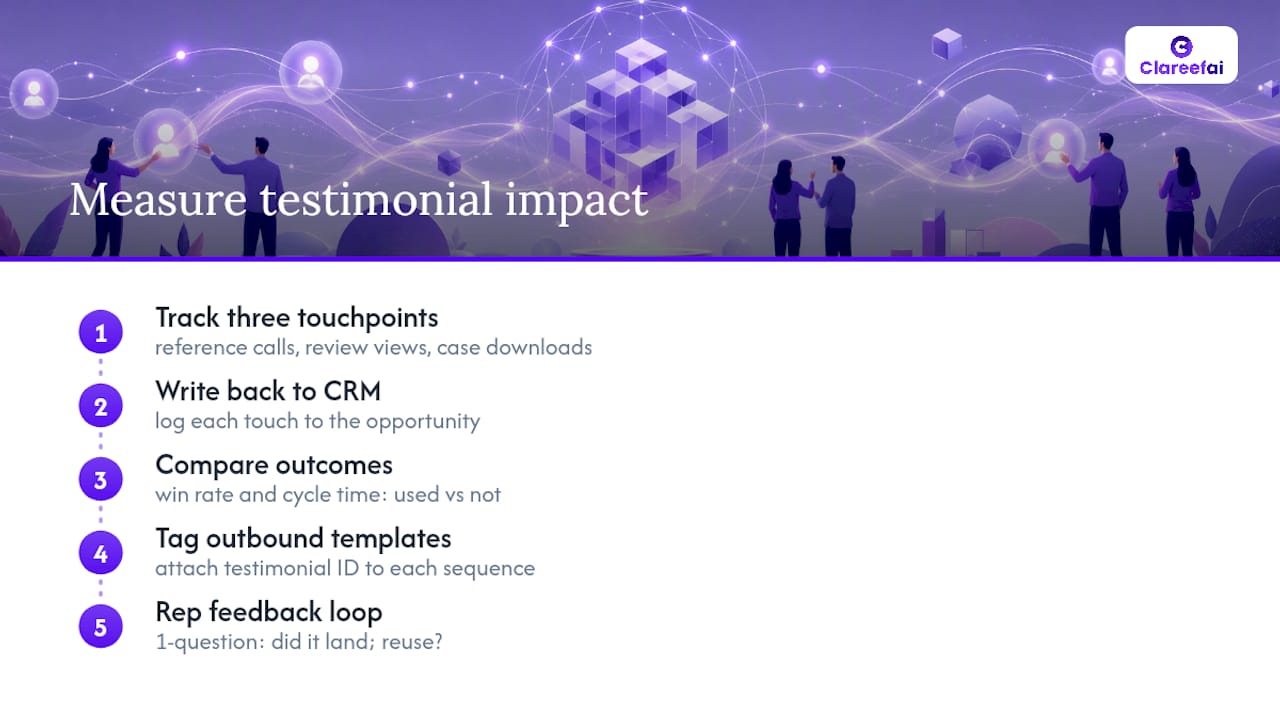
From there, run the comparison that actually matters: win rate and average cycle time for deals that used a testimonial asset versus deals that didn’t. Most teams find a meaningful gap once they segment this way, though the size varies by industry and deal size, so measure your own baseline before promising a specific lift internally.
Tag every outbound template and sequence with a testimonial ID. That lets you see, at the template level, which specific customer story drives the best reply and meeting-booked rates, rather than guessing which quote “feels” strongest.
Finally, build a feedback loop with reps. After a call where they used a reference or clip, ask a one-question survey: did it land, and would they use it again? That signal is what refines your matching logic over time, so the system gets better at recommending the right asset for the right objection instead of just the newest one in the library.
How Do You Manage Advocate Load Without Burning Out Your Best Customers?
Your best customers are also your most requested ones, and that’s a governance problem, not a nice-to-side-effect. Set a firm utilization threshold, for example a small number of reference calls per advocate per quarter, and enforce it automatically rather than trusting individual reps to remember.
Broaden your advocate base deliberately. If the same five names get pulled into every deal, rotate in newer promoters and retire overused ones for a quarter. Ranking matches by recent utilization instead of just “who said yes last time” keeps the pool healthy.
Reciprocity keeps advocates engaged longer than a one-time gift card ever does. Early access to new features, public recognition, or a seat on an advisory council tends to sustain participation far better than transactional incentives.
Pro Tip: Build the utilization counter directly into your CRM object, and set it to auto-block new requests once an advocate hits their quarterly cap. Manual tracking always slips.
Disclosure matters too. Any testimonial used in outreach or advertising needs a clear, accurate representation of the relationship, consistent with FTC guidance on endorsements, and needs to respect whatever terms the customer agreed to when they gave consent.
What Does an Implementation Roadmap Look Like?
Build in two phases: an MVP you can launch in weeks, and a scaled system you grow into over quarters.
- MVP stage. Create a custom CRM object for testimonials with a consent flag, connect it to a simple asset store (even a well-organized folder structure tied to account IDs works at first), and build a lightweight matching interface so reps can search by objection or role.
- Scale stage. Add automated matching that ranks assets by recency and utilization, filter out advocates who’ve hit their cap, publish case studies as indexed HTML with Article+ClaimReview schema instead of static PDFs, and connect syndication endpoints to review platforms so new verified reviews flow back into your library automatically.
- Prioritize integrations in this order: CRM first, since everything else depends on it, then your CMS for schema-marked publishing, video hosting for testimonial clips, review-platform APIs, and finally analytics to close the attribution loop.
This is roughly how ClareefAI approaches the problem for mid-size and enterprise teams: role-based dashboards for sales, marketing, and customer success, three-factor identity verification built into the collection flow, and analytics that tie testimonial usage back to specific deals. Our step-by-step testimonial workflow walks through how the collection-to-syndication pipeline maps onto these integration priorities in practice.
How Should You Handle Negative Testimonials in Your Syndication Strategy?
Not every piece of customer feedback is going to be usable, and pretending otherwise undermines the credibility you’re trying to build. A syndication strategy needs a clear path for critical or mixed feedback instead of just a pipeline for glowing quotes.
First, separate feedback collection from testimonial collection. When a customer flags a real problem during an NPS survey or a CS check-in, that goes to product or support immediately, not into your proof library. Trying to spin a negative comment into marketing copy erodes trust faster than having no testimonial at all.
Second, build a “mixed but honest” tier for testimonials that include a real caveat: “the onboarding took longer than we expected, but support stayed responsive.” These are often more persuasive to skeptical buying committees than uniformly glowing ones, because they read as credible rather than curated. Tag them separately so reps know when a slightly imperfect story fits the moment better than a flawless one.
Third, if a customer’s public review skews negative on a third-party platform like G2, respond there directly and factually, and route the underlying issue to whoever owns the account relationship. Never attempt to bury or suppress a legitimate review; instead, work to earn an updated one once the issue is resolved, and let your verification process confirm that update is authentic when it comes in.
Finally, set a review cadence, quarterly is reasonable, to audit your proof library and retire testimonials tied to features you’ve since changed or customers who’ve churned. Stale proof is its own credibility risk.
ClareefAI Perspective: Lessons From Running Testimonial Programs at Scale
Most teams treat testimonials as marketing collateral. We think that’s the mistake. Treat them as data objects, with metadata rich enough that a rep can query for “CFO, cost objection, mid-market” and get a usable clip in seconds, and the whole program behaves differently.
One placement makes this obvious fast: a 60-second CFO clip on your pricing page, addressing payback period directly. It sits at the exact moment cost anxiety peaks, and it works because it’s tagged and placed with intent, not because it’s simply present. You can see how that kind of unified management maps to measurable win-rate impact in practice.
— ClareefAi
How Can ClareefAI Help You Put This Into Practice?
If you’ve been managing testimonials in spreadsheets and shared drives, ClareefAI is the structural upgrade: verified identity checks instead of screenshotted quotes, role and ARR tagging built into collection instead of added after the fact, and analytics that tie every asset back to a real deal outcome. It covers the same five components this guide just walked through: collection, verification, tagging, syndication, and measurement, inside one connected system instead of five disconnected tools.
Role-based dashboards mean your sales, marketing, and customer-success teams each see the view they need without stepping on each other’s workflows, and GDPR-aligned data handling keeps consent and identity records audit-ready as your advocate base grows. If you’re ready to see how it fits your current CRM and CMS stack, start with the platform overview or explore the role-specific solutions built for sales, marketing, and management teams, and book a walkthrough to see your own proof library mapped out before you commit to anything.
Sources
For deeper implementation detail, Octave’s guide to customer advocacy covers advocate database design and utilization tracking in depth. Idukki’s B2B UGC playbook is the strongest reference on schema-marked case studies and syndication endpoints. Holler’s testimonial video guide breaks down video cut strategy in detail, and Apollo’s cold outreach guide covers compliant testimonial placement in email sequences.
On the ClareefAI blog, our posts on video testimonial advantages and boosting sales credibility expand on the workflow and rep-facing tactics covered above.
- Octave | The GTM Engineer’s Guide to Customer Advocacy
- b2b-saas-ugc-playbook
- How to Use Client Testimonial Videos to Shorten the B2B Sales Cycle | Holler
- How to Integrate Customer Testimonials in Cold Outreach | Apollo
Recommended
Share Article
Stay Updated
Get the latest insights on customer advocacy and SaaS growth delivered to your inbox.