
Social proof governance is the set of rules, owners and records that decide which customer testimonials, reviews, logos and numbers your company may publish, where, for how long, and on what evidence. It turns customer praise into assets your sales team can use without worrying about a retraction, a legal letter or a prospect who spots an outdated quote. The most reliable way to run it is to verify each piece of proof once, store the consent and context with it, and publish from one central system. That is the approach Clareefai is built around.
TL;DR
- Governance means every proof asset has a verified speaker, written consent, an approved scope and an expiration date.
- Run each asset through five release questions: who said it, what supports it, what use was approved, is it still accurate, and does it answer this buyer’s concern.
- Since October 21, 2024, the FTC’s rule on consumer reviews and testimonials bans fake reviews and requires disclosure of material connections, so incentives and insider reviews need clear handling.
- Split ownership: marketing sources and stores stories, customer success manages the advocate, legal approves usage, and RevOps governs reporting.
- Measure governed proof through response rates, meeting conversion and sales cycle length, and report the lift conservatively.
Table of Contents
- Why B2B teams need governance, not just more testimonials
- What a governance framework actually contains
- Step 1: Set an evidence standard for every proof type
- Step 2: Capture consent that covers real-world use
- Step 3: Build the FTC rules into the workflow
- Step 4: Assign owners and write them down
- Step 5: Put an expiration date on every asset
- Step 6: Measure impact without overstating it
- Where Clareefai fits
- Our perspective
- FAQ
- Sources
Why B2B teams need governance, not just more testimonials
Buyers lean on peers more than on anything you publish yourself. In a SurveyMonkey and Reddit study reported in March 2026, 73% of B2B decision-makers said they trust peer recommendations above vendor websites, and 83% research on their own before talking to sales. Your proof is often the first thing a prospect reads about you, and no rep is in the room to explain it.
That is where unmanaged proof backfires. A quote from a champion who left the customer two years ago, a case study with a metric nobody can reproduce, or a logo on a slide for a relationship that ended: each one is a small credibility leak. Governance closes those leaks. It does not slow marketing down. It lets sales and marketing publish quickly because every asset has already passed the same gate.
Peer proof also travels further than it used to. G2’s 2025 Buyer Behavior Report, as covered by Demand Gen Report, found that leads arriving through AI-powered search convert roughly 40% better than those from traditional search, largely because buyers meet credible third-party content earlier. Whatever you publish now can be surfaced out of context, which makes context part of governance too.
What a governance framework actually contains
A workable framework has five parts. Each maps to a decision your team makes weekly.
- Evidence standards. What must exist before an asset goes live.
- Consent and rights. Who agreed, to what, where, and for how long.
- Compliance rules. FTC disclosure and review-handling requirements for the US.
- Ownership. Who creates, approves, publishes and retires proof.
- Lifecycle and measurement. When assets are reviewed, refreshed or removed, and how you judge their impact.
A governance framework from Share One describes the same elements: consent management, legal review, brand standards and content lifecycle controls that keep messages consistent and reduce brand risk. Used together, they make customer stories a scalable marketing asset rather than a one-off favor.
Step 1: Set an evidence standard for every proof type
The simplest control is a release gate. Marketing Scoop’s social proof credibility audit proposes five questions to answer before publishing any claim:
- Who said it?
- What supports it?
- What use was approved?
- Is it still accurate?
- Does it answer this audience’s actual concern?
The audit also holds that you should verify both the underlying evidence and the message a reasonable visitor will take away. A quote can be real and still mislead if it implies a result the customer never got.
What you keep on file depends on the asset. The same audit lists the records to retain:
| Proof type | Evidence to keep on file |
|---|---|
| Testimonial | Original message or recording, verified speaker identity, approved wording |
| Case study | Customer confirmation, measurement definitions, comparison periods |
| Review | Original location, date, product reviewed, capture date |
| Customer logo | Evidence of the exact relationship |
| Numerical claim | Reproducible calculation, inclusion rules, timestamp |
If you want a second perspective on how to document different marketing claims, this guide to social proof credibility audits covers the same ground.
The common failure is storage. The quote lives in a Slack thread, the approval in someone’s inbox, the recording on a shared drive. When legal asks for proof six months later, nobody can assemble it. Clareefai keeps testimonials, reviews, case studies and reference calls in one centralized, secure system and verifies customer identities, so the speaker, the context and the asset sit together from the start.
If you also want the sequence of checks a rep or marketer follows before something goes live, our B2B social proof workflow lays it out step by step.
Step 2: Capture consent that covers real-world use
Most testimonial disputes come from scope, not from the quote itself. A customer agreed to a blog mention, and the quote then appears in a national ad. Or the reply was “looks good” and nothing more.

A B2B consent record should state who is consenting, what they consent to, where the content may appear, how long the permission lasts, and whether you may edit the wording. Compliance analysis from businesslaws.xyz adds two points that matter in B2B: the consent should cover media formats, regions, channels and duration, and you should confirm that the person speaking for a company has authority to approve use of its name.
For the US, a few practical points apply:
- Written permission to use a person’s name, likeness and words protects you from a right-of-publicity claim. LegalClarity’s template guide notes that no single federal law requires a revocation right for standard commercial testimonials, but a clear revocation process still protects you against complaints and state-level privacy claims.
- Under the federal E-SIGN Act, an email reply can count as consent if the terms were spelled out beforehand, according to ProofMap’s release form overview. A vague reply does not.
- Names, job titles, company names, email addresses, screenshots and product usage data in a story should be treated as personal or proprietary data. Minimize details, redact where possible, limit access before publication, and check whether the customer’s company restricts public references.
Before anything goes live, check the published version against the signed consent: same platforms, same meaning, any incentive disclosed. A confirmation email at submission gives you a timestamped record that the contribution was voluntary.
Step 3: Build the FTC rules into the workflow
US marketers now work under two layers of FTC guidance. The first is the revised Endorsement Guides (16 C.F.R. Part 255), finalized in June 2023. As summarized by Supply Side West, they make advertisers liable for procuring fake reviews and for unsubstantiated claims in them, and they treat any edit that distorts what a reviewer thinks as deceptive.
The second is the Consumer Reviews and Testimonials Rule (16 CFR Part 465), effective October 21, 2024. Per a Lexology summary of the final rule, it prohibits selling or buying fake consumer reviews, purchasing positive or negative reviews, and conditioning incentives on a particular sentiment. It also requires disclosure for insider reviews and testimonials.
What that means for a B2B team in practice:
- Incentives are allowed, sentiment conditions are not. You can thank customers for a review, but the reward cannot depend on a 5-star rating or a positive tone. That provision, per the same analysis, applies to reviews on sites dedicated to receiving and displaying reviews, not to social media testimonials.
- Disclose material connections. Bryan Cave Leighton Paisner explains that business, family or personal relationships, payment, free or discounted products, early access and prize chances need a clear and conspicuous disclosure when a significant minority of the audience would not expect them. Its general recommendation is to disclose incentivized reviews.
- Know the difference between a review and a testimonial. FTC staff guidance, as reported in November 2024, treats a review as something submitted to a platform dedicated to evaluations, and a testimonial as a type of endorsement. Your team needs to label which one each asset is.
- Do not suppress or reshape. The rule also targets deceptive suppression of negative reviews and company-controlled sites that pretend to be independent, according to Anderson Collaborative.
We cover a repeatable verification sequence in our six-step workflow for FTC testimonial guidelines. For legal questions about a specific program, your counsel makes the final call.
Step 4: Assign owners and write them down
Governance fails when everyone assumes someone else owns it. Marketing, sales and regional teams use proof differently, so a shared approval system matters more than any single policy document.
The Pedowitz Group describes a Revenue Marketing ownership model that is a useful starting point:
| Role | Owns |
|---|---|
| Product marketing or advocacy | Story sourcing, rights, asset quality |
| Customer success | Advocate relationships and outcomes |
| Lifecycle marketing | Placement across buyer journeys |
| RevOps | Taxonomy, attribution, funding |
| Legal and brand | Usage rights, expiration, compliance archive |
Pair that with a charter, a RACI chart, and permissions tied to a purpose with expirations and renewals. Two habits make it stick:
- Customer success asks, marketing publishes. The person with the relationship makes the request, which keeps outreach personal and stops five teams from emailing the same champion.
- One approval trail. Pre-production confirms signed consent, usage rights, legal-reviewed language and interview guidance. Post-production documents final legal sign-off and checks that every meaningful claim can be supported.
Clareefai offers dashboards for different roles, so each team sees what it needs to act on, and it synchronizes data in real time. That keeps customer success, sales and marketing working from the same record instead of three spreadsheets.
Step 5: Put an expiration date on every asset
Testimonials age. Share One’s framework points out that risk rises when a customer changes jobs, a product feature disappears, or disclosure requirements change. Lifecycle governance answers that with review cycles, retention rules, archival triggers and sunset dates.
A simple lifecycle policy looks like this:
- Set a review date at publication. Many teams pick 12 months, then adjust by asset type: a pricing-related claim ages faster than a story about onboarding.
- Define triggers for early review. The speaker leaves the customer, the customer is acquired, the product changes, or a rule changes.
- Choose an outcome. Reconfirm and renew, update with the customer’s approval, or archive.
- Keep the archive. A retired asset still needs its consent and evidence on file in case a past claim is questioned.
This is also where dynamic proof helps. Instead of pasting a static quote into twenty decks, you publish from one verified source and update it once. Our guide to dynamic social proof with a verified, FTC-safe workflow goes deeper.
Step 6: Measure impact without overstating it
Governance should not make you claim more than the data shows. Start with measures your own funnel can verify:
- Email open and response rates with versus without a testimonial.
- Meeting conversion rates when a case study is shared before the call.
- Sales cycle length when proof is used early in the process.
Those are the metrics RevNew recommends tracking. It cites SalesLoft data showing that B2B organizations that systematically integrate testimonials and case studies into outbound sequences see an average 32% higher response rate than product-focused messaging. Treat that as an industry reference point, not a promise. Your own with-and-without comparison is the number to report internally.
A few habits keep reporting honest:
- Compare like with like: same segment, same period, same sequence.
- Report the lift as a range and say how many accounts it covers.
- Do not credit proof for deals it only touched. Map the asset to the CRM stage where it was used.
We show how to set up those tests and map them to CRM fields in proving social proof ROI.
Where Clareefai fits
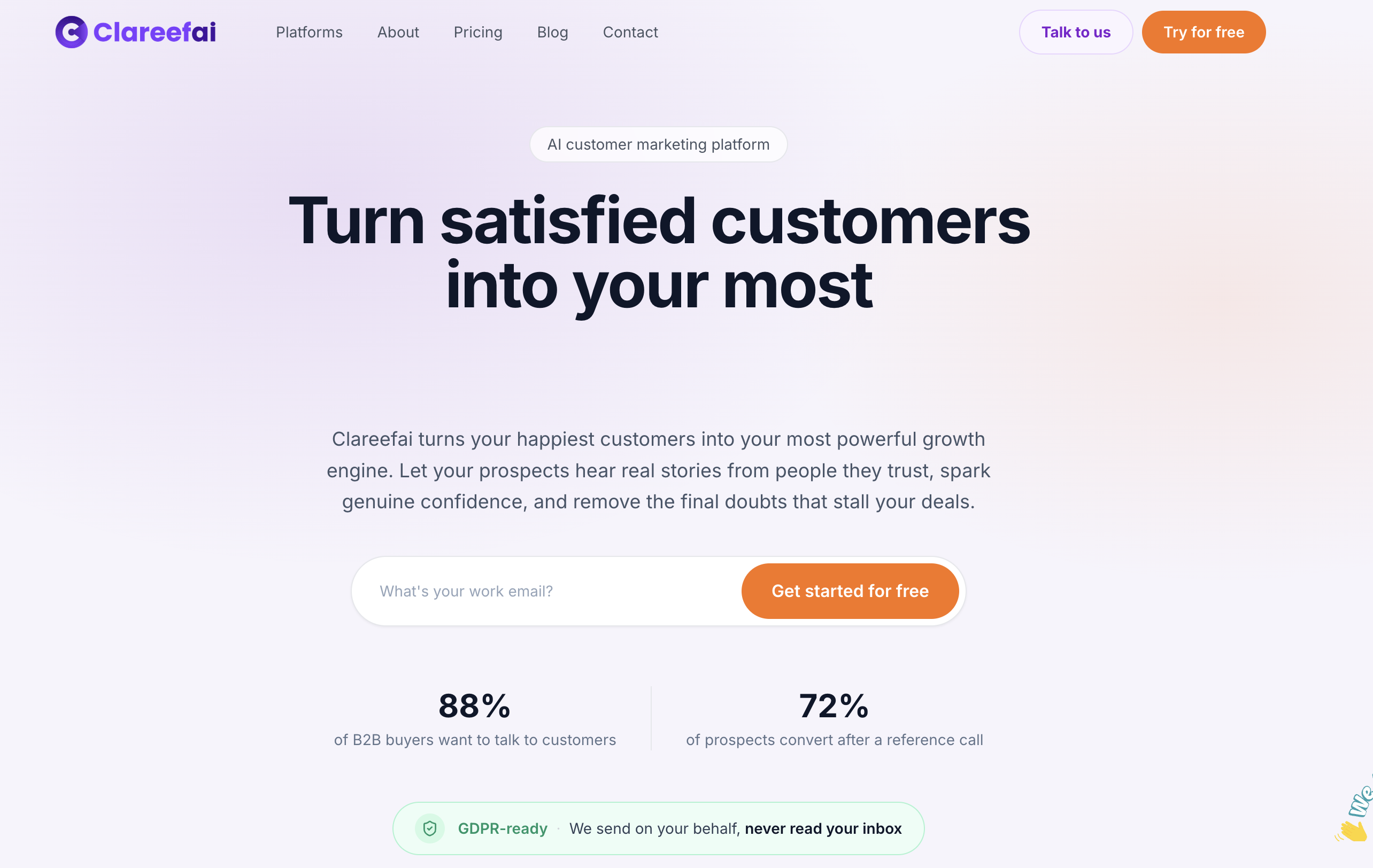
Governance is easiest when verification, consent, publishing and reporting happen in one place. Clareefai is a subscription platform for B2B sales and marketing teams that collects, verifies, categorizes and showcases customer testimonials (text and video), reference calls, reviews, case studies and advocacy programs. It uses AI to identify and match promoters, publishes across channels through CRM and review integrations, keeps data GDPR-compliant, and reports on advocacy through analytics dashboards.
Plans are billed monthly or annually with no long-term contracts, and a free trial is available. Basic is $250 per month, Professional is $624 per month and Enterprise is $1,250 per month, with white-label and custom integrations on Enterprise. You can compare them on the Clareefai pricing page.
If you want to see how unified testimonial management supports win rates, start with our use case on boosting win rates, or look at the full platform.
Our perspective
We believe the strongest social proof is proof a prospect can trust without having to wonder. That takes more than a good quote. It takes a verified person, a clear context and a record that shows the customer agreed.
Anonymous or generic reviews rarely move a serious B2B buyer. A named promoter from a similar company, speaking in their own words and on video where possible, does. That is why Clareefai verifies customer identities and contextualizes each testimonial, so informal praise becomes a sales asset your team can stand behind.
Governance is also what makes advocacy scale. When customer success, marketing and sales share one system, you can identify your best promoters with AI, match them to the right deals, and offer instant reference calls with real customers, all with the consent and the data protections already in place.
Our advice: start with the release gate, name an owner for each stage, and let your analytics show which governed stories help deals move.
ClareefAi
FAQ
What is social proof governance?
It is the policy and process that controls how customer testimonials, reviews, logos, case studies and numbers are verified, approved, published and retired. A good program defines evidence standards, consent, compliance checks, owners and review dates. The goal is proof that holds up when a buyer, a lawyer or a competitor looks closely.
Do we need written consent for a B2B testimonial?
It is the safest practice. Written permission to use a person’s name, likeness and words reduces the risk of a right-of-publicity claim, and the consent should name the channels, duration and editing rights. Confirm that the person has authority to approve use of their company’s name. Your legal counsel should approve the final template.
Does the FTC’s fake review rule apply to B2B companies?
The rule on consumer reviews and testimonials took effect on October 21, 2024, and it covers fake reviews, review buying, insider reviews and suppression of negative reviews. Rather than guess where the line falls for a given asset, many B2B teams apply the same standards to all published proof. Ask your counsel how it applies to your specific program.
How often should we review published testimonials?
Set a review date when each asset goes live, commonly annually, and add triggers such as the speaker changing jobs, a product change or a rule change. At review, reconfirm, update with approval or archive. Keep the consent and evidence on file after retirement.
Sources
- Trust is the New Currency in B2B Buying (Demand Gen Report)
- The New Demand Engine: Why Peer Proof Is Reshaping the B2B Buying Journey (Demand Gen Report)
- Enterprise Testimonial Governance Framework (Share One)
- A Social Proof Credibility Audit (Marketing Scoop)
- Social proof strategies to boost engagement
- Testimonial Form Template: Fields, Consent, and FTC Rules (LegalClarity)
- Testimonial Release Form for B2B Marketing (ProofMap)
- Breaking down the latest from the FTC on endorsements and consumer reviews (Supply Side West)
- FTC publishes final rule banning fake consumer reviews (Lexology)
- What the FTC’s final rule means for incentivized reviews (Bryan Cave Leighton Paisner)
- FTC Staff Publishes Guidance on the Consumer Reviews and Testimonials Rule (Keating & Chan)
- Social Proof: Types, Proof, and Disclosure (Anderson Collaborative)
- Who owns advocacy programs in a Revenue Marketing model? (The Pedowitz Group)
- Utilizing Social Proof To Drive more B2B Sales with trust (RevNew)