Why Real-Time Data Sync Matters for Ops and Decisions
TL;DR:
- Real-time data synchronization ensures all systems and teams act on the latest information, reducing errors and meeting SLAs. It is essential for workflows where data freshness within seconds influences decisions and compliance, unlike batch syncs that cannot meet tight acknowledgment windows.
Real-time data synchronization ensures every team and system acts on the same current state, reducing errors, accelerating decisions, and keeping SLAs within reach. If your operations depend on data freshness measured in seconds rather than hours, this is the capability that separates reactive firefighting from proactive control.
TL;DR:
- Faster incident resolution: real-time visibility lets teams respond before SLA windows close
- Accurate customer views: every touchpoint reflects the latest interaction, not yesterday’s snapshot
- AI and automation readiness: fresh data feeds are a prerequisite for reliable model performance
- SLA adherence: batch sync cannot meet sub-acknowledgment windows within minutes that many managed service agreements require
Quick decision check: Ask yourself whether a 30-minute data delay would change the action your team takes. If yes, real-time sync deserves a serious look.
Table of Contents
- What is real-time data synchronization, and how does it differ from batch sync?
- How does real-time sync actually work under the hood?
- One-way vs. two-way sync: which topology fits your use case?
- 1. Incident management and SLA compliance
- 2. Inventory and order management
- 3. Customer 360 and personalization
- 4. Fraud detection
- 5. Financial event reconciliation
- 6. IoT and telemetry
- 7. AI model feedback loops
- 8. Cross-company collaboration without credential sharing
- How do you decide between real-time, near-real-time, and batch?
- What are the real trade-offs and risks of real-time sync?
- A practical implementation checklist for real-time sync pipelines
- What metrics and SLAs should you track for real-time sync?
- What analysts and researchers say about real-time sync’s strategic value
- Key Takeaways
- What engineers who have built real-time pipelines actually learned
- How Clareefai puts real-time sync to work for customer-facing data
- Useful sources for further research and implementation planning
What is real-time data synchronization, and how does it differ from batch sync?
Data synchronization is the process of keeping multiple systems consistent as records change. Real-time sync narrows that window to milliseconds or seconds, using event-driven architectures such as Change Data Capture (CDC), webhooks, and streaming APIs to propagate updates the moment they occur.
That is meaningfully different from its alternatives:
- Data integration/centralization — moves data into a single store for analytics. As Oracle’s documentation clarifies, synchronization keeps multiple systems consistent while integration centralizes data for analysis. Both can coexist in the same architecture.
The operational gap becomes concrete when you consider SLA requirements. Certain managed service agreements require incident acknowledgment within 15 minutes. An hourly batch job simply cannot meet that threshold. Real-time sync is not a luxury in those contexts; it is a contractual necessity.
How does real-time sync actually work under the hood?
Two fundamental approaches drive real-time data movement: event-driven and polling.
Polling asks the source system “has anything changed?” on a fixed interval. It works, but it adds query load to production databases and introduces latency equal to the polling frequency. Event-driven architectures flip that model: the source system emits a signal when a change occurs, and downstream consumers react immediately.
Core mechanisms:
- CDC (log-based change capture): — Reads the database transaction log (e.g., PostgreSQL’s Write-Ahead Log) rather than querying tables directly. This minimizes production load and captures every insert, update, and delete. Replication slot lag must be monitored closely to prevent the log from growing unbounded.
| Mechanism | Typical latency | Best for | Key operational cost |
|---|---|---|---|
| CDC / log-based | Milliseconds | Operational DB replication | Replication slot monitoring |
| Webhooks | Sub-second | SaaS integrations | Endpoint reliability, retry logic |
| Message queues | Milliseconds–seconds | Decoupled microservices | Queue depth monitoring |
| Streaming platforms | Milliseconds–seconds | High-volume telemetry, analytics | Infrastructure and tuning overhead |
| Polling | Seconds–minutes | Legacy systems, low-change data | Production query load |
Pro Tip: Choose your delivery guarantee deliberately. At-most-once drops duplicates but risks data loss. At-least-once guarantees delivery but may produce duplicates. Exactly-once is safest but costly to implement. Whatever you choose, design every consumer to be idempotent so that processing the same event twice produces the same result.
One-way vs. two-way sync: which topology fits your use case?
Not every sync relationship needs to flow in both directions, and choosing the wrong topology creates unnecessary conflict-resolution work.
One-way (unidirectional) sync propagates changes from a single source of truth to one or more downstream systems. Common scenarios include:
- Replicating a production database to a read replica for reporting
- Pushing CRM contact updates to a billing system
- Syncing a product catalog from an ERP to an e-commerce storefront
Two-way (bidirectional) sync allows changes on either side to propagate to the other. This is the right choice when two teams or systems both need write access to shared records, such as syncing support tickets between a customer-facing tool and an internal engineering tracker.
Bidirectional sync introduces conflict resolution, which you must design for explicitly:
- Last-write-wins: The most recent timestamp takes precedence. Simple, but can silently discard valid updates if clocks are skewed.
- Source-priority rules: One system is designated authoritative for specific fields. A CRM owns the customer name; the billing system owns the contract value.
- Per-field merge logic: Each field has its own resolution rule. Useful when different teams own different parts of the same record.
- Custom merge functions: Applied when business logic is too complex for a simple rule, such as reconciling two different discount values applied by separate sales reps.
A practical example: a support team uses Zendesk while the engineering team tracks bugs in Jira. A two-way sync keeps ticket status aligned across both tools without requiring either team to change their workflow. When both sides update the priority field simultaneously, source-priority rules assign ownership to the system where the change originated.
1. Incident management and SLA compliance
When an alert fires, every second of delay between detection and acknowledgment counts against your SLA clock. Real-time sync ensures that the monitoring system, the ticketing platform, and the on-call dashboard all reflect the same incident state simultaneously. Teams that rely on hourly batch updates routinely miss the 15-minute acknowledgment windows that managed service contracts require.

2. Inventory and order management
E-commerce and logistics operations depend on accurate stock counts. A customer who orders an item that sold out three minutes ago creates a support ticket, a refund, and a damaged trust relationship. Real-time sync between warehouse management systems and the storefront prevents overselling by propagating inventory changes the moment a pick is confirmed.

3. Customer 360 and personalization
A complete, current customer profile drives better sales conversations and more relevant marketing. When CRM data, support history, and product usage metrics sync in real time, a sales rep opening an account record sees the customer’s last support ticket, their current subscription tier, and their most recent product activity, all at once. That context changes the conversation.
4. Fraud detection
Fraud models need the freshest transaction data to catch anomalies before they compound. A payment flagged at 2:03 PM is only actionable if the fraud system sees it at 2:03 PM, not at the next batch window. Real-time sync between transaction processors and risk engines is standard practice in financial services for exactly this reason.
5. Financial event reconciliation
Closing the books accurately requires that every system, from payment processors to ERP to revenue recognition tools, reflects the same transaction state. Real-time sync reduces the reconciliation gap and cuts the manual effort of hunting down discrepancies that batch windows create.
6. IoT and telemetry
The number of connected IoT devices worldwide continues to grow rapidly, and each device generates a continuous stream of sensor readings. Predictive maintenance, fleet tracking, and smart building management all require near-instantaneous data propagation to act on anomalies before they become failures.
7. AI model feedback loops
AI systems degrade when their training and inference data goes stale. Organizations that delay data feeds frequently erode model performance and reduce the usefulness of feedback loops. Real-time sync keeps recommendation engines, churn prediction models, and personalization algorithms operating on current signals. This connection between fresh data and AI performance is one of the strongest strategic arguments for investing in real-time infrastructure.
8. Cross-company collaboration without credential sharing
Real-time sync eliminates manual handoffs and reduces errors while enabling cross-company collaboration without sharing credentials. Two organizations can keep shared project data aligned without granting each other direct database access, which shrinks the attack surface considerably.
How do you decide between real-time, near-real-time, and batch?
The right choice depends on whether data freshness actually changes the action you take. More latency tolerance means lower cost and complexity. Use this checklist before committing to real-time:
Decision checklist:
- Does a 5-minute data delay change the decision or action your team takes?
- Does your SLA require acknowledgment or response within minutes?
- Are end users directly interacting with this data in real time (live dashboards, customer-facing UIs)?
- Can your team absorb the operational overhead of monitoring and maintaining a streaming pipeline?
- Does the data contain PII or regulated fields that require encryption in transit and access controls?
Three example scenarios:
-
Real-time: A support platform syncing ticket status to an engineering tracker. Engineers need to see customer-reported severity the moment it changes. Latency of even a few minutes can cause duplicate work or missed escalations.
-
Near-real-time: A marketing analytics dashboard refreshed every 5 minutes. Campaign managers need reasonably current data to adjust spend, but a 5-minute lag does not change any decision they would make.
-
Batch: A monthly financial report aggregating revenue by region. The data is inherently historical; nightly batch processing is entirely sufficient and far cheaper to operate.
Vendor and engineering guides consistently recommend making a narrow set of operational signals real-time and keeping the rest on calmer batch cadences. This hybrid approach manages complexity and cost without sacrificing the freshness that actually matters.
What are the real trade-offs and risks of real-time sync?
Real-time sync is not free. Before you commit, understand the operational costs and failure modes you are signing up for.
Major risks:
- Increased complexity: More moving parts mean more failure modes. A streaming pipeline has producers, consumers, brokers, schema registries, and monitoring layers, each of which can fail independently.
- Higher operational cost: Streaming infrastructure (Kafka clusters, CDC connectors, managed streaming services) carries ongoing compute and storage costs that batch ETL does not.
- Wider attack surface: Data in motion crosses more network boundaries. Encryption in transit (TLS), role-based access controls, and audit logging are non-negotiable.
- Schema drift: When a source system changes a field name or type, downstream consumers break. Without a schema registry and a versioning strategy, a single migration can cascade into multiple pipeline failures.
- Replication lag: CDC-based pipelines can fall behind under heavy write loads. Unmonitored replication slot lag in PostgreSQL, for example, can cause the WAL to grow until disk space is exhausted.
- Hidden data-quality problems: Real-time sync often surfaces preexisting inconsistencies that batch windows had masked. Teams should budget time for an initial period of data debugging and reconciliation after going live.
Mitigation strategies:
- Enforce idempotency on all consumers so duplicate events do not corrupt state
- Implement backpressure handling to prevent consumers from being overwhelmed during traffic spikes
- Use exponential backoff with retry limits and dead-letter queues for failed events
- Set up alerting on freshness lag, error rates, and replication slot depth
- Encrypt all data in transit and apply field-level access controls for sensitive records
- Adopt a schema registry (e.g., Confluent Schema Registry) and enforce backward-compatible schema evolution
The hidden work after go-live, particularly data debugging and resolving conflicting definitions of truth between systems, is consistently underestimated. Set stakeholder expectations early.
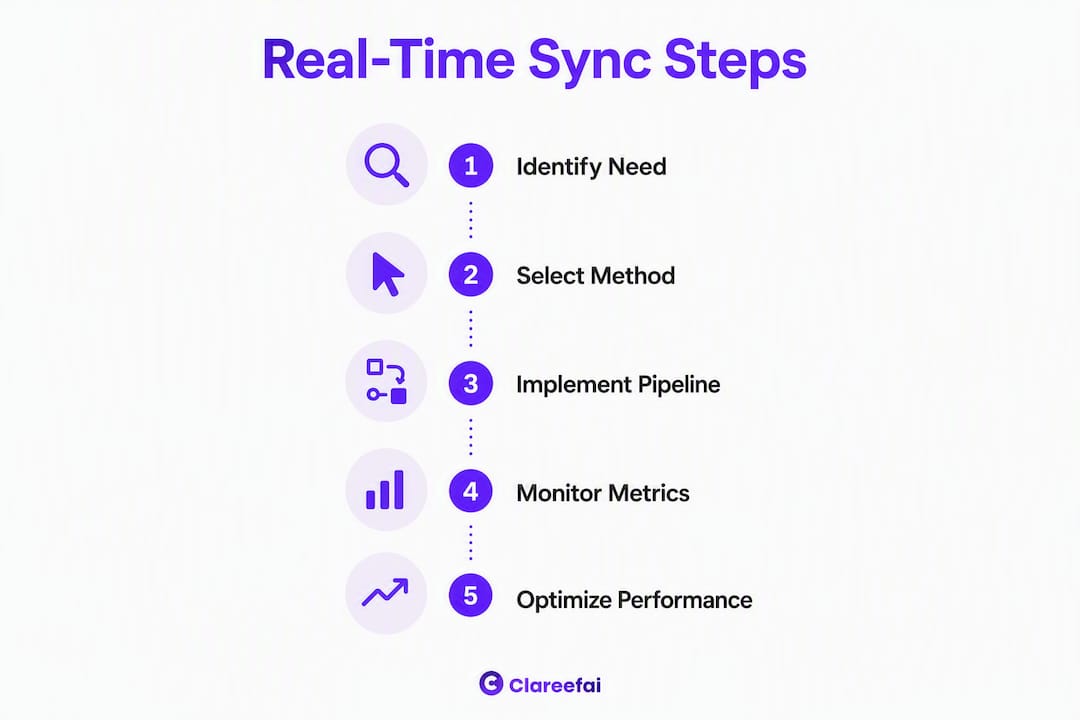
A practical implementation checklist for real-time sync pipelines
Getting real-time sync right requires deliberate engineering decisions at every layer. Work through these steps before you write a line of pipeline code.
- Select the right transport — Match the mechanism to your source system: CDC for relational databases, webhooks for SaaS APIs, streaming platforms for high-volume event streams.
Pro Tip: Start with a single, high-value, low-risk data stream rather than migrating your entire data layer at once. Pick one workflow where latency genuinely changes decisions, get it stable and well-monitored, then expand. This narrow-first approach surfaces operational surprises in a contained environment.
What metrics and SLAs should you track for real-time sync?
Tracking the right metrics is what separates a pipeline that works in theory from one you can defend in a post-incident review.
Metrics to monitor:
- Replication slot lag: — For CDC pipelines, the number of bytes or transactions the consumer is behind the source log.
Sample SLA thresholds:
| Stream / use case | Freshness target | p99 latency target | Delivery success rate |
|---|---|---|---|
| Incident ticket visibility | Under 30 seconds | Under 5 seconds | — |
| Inventory count updates | seconds-level latency | seconds-level latency | — |
| Customer profile sync (CRM) | Under 2 minutes | Under 30 seconds | — |
| Financial event reconciliation | Under 5 minutes | seconds-level latency | — |
| Analytics dashboard refresh | minutes-level latency | Under 2 minutes | — |
Translating these technical metrics into business outcomes is the step most teams skip. A p99 latency breach on your incident ticket stream is not just an engineering metric; it is a direct path to an SLA violation and a service credit. Frame your monitoring dashboards in business terms so that executives and SREs are reading the same signal.
What analysts and researchers say about real-time sync’s strategic value
The business case for real-time data practices extends well beyond engineering efficiency.
- Gartner-cited analysis shows that companies adopting real-time data integration improve decision-making speed and gain competitive advantage. AI initiatives that depend on real-time data access are expected to raise long-term economic impact.
- Organizational alignment is one of the most underappreciated benefits. When multiple teams operate on the same recent state, the organization stops debating whose data is correct and starts taking coordinated action. That shift from data arguments to decisions is where real-time sync moves the needle on productivity.
- Fresh data is a prerequisite for AI-driven use cases. Organizations that delay data feeds frequently erode model performance and reduce the usefulness of feedback loops. As AI becomes embedded in more operational workflows, the dependency on data freshness only deepens.
- Analytics-driven marketing depends on the same freshness principle: stale data fed into personalization engines produces generic, poorly timed outreach that underperforms.
- The hidden cost that analysts rarely quantify is the data debugging phase after go-live. Real-time sync exposes inconsistencies that batch windows had quietly absorbed. Budget for it, and set stakeholder expectations before the pipeline goes live, not after.
The practical implication for leaders: the ROI of real-time sync is not just faster pipelines. It is fewer escalations, fewer manual reconciliation cycles, and AI systems that actually perform as advertised.
Key Takeaways
Real-time data synchronization delivers measurable operational value when applied selectively to workflows where data freshness directly changes decisions or SLA outcomes.
| Point | Details |
|---|---|
| Match latency to the decision | Only apply real-time sync where a delay changes the action taken; batch is better for reporting and historical analysis. |
| SLA compliance depends on freshness | Incident acknowledgment windows shorter than an hour cannot be met with hourly batch sync; real-time pipelines are a contractual requirement in those cases. |
| Start narrow, then expand | Pick one high-value stream, get it stable and monitored, then grow the real-time surface incrementally. |
| Budget for data debugging | Real-time sync surfaces preexisting data-quality problems; plan for an initial reconciliation phase before declaring success. |
| Clareefai brings real-time sync to customer advocacy | Clareefai’s platform applies real-time data synchronization to testimonial and review workflows, keeping sales and marketing teams working from current customer data. |
What engineers who have built real-time pipelines actually learned
The gap between a working proof-of-concept and a production-grade real-time pipeline is wider than most teams expect. Three lessons come up consistently among engineers who have shipped these systems.
Start narrower than you think you need to. The instinct is to migrate everything at once. The reality is that each stream you add multiplies your failure surface. Pick the single workflow where latency most directly affects a business outcome, get it right, and use that experience to calibrate your estimates for the next one.
Instrument before you go live, not after. End-to-end latency percentiles, replication slot lag, and event delivery success rates need to be visible from day one. Retrofitting observability into a live pipeline is painful and slow. Build the dashboards before you flip the switch.
Automate reconciliation from the start. Manual spot-checks do not scale. Scheduled row-count comparisons and checksum validations between source and destination catch silent drift before it compounds into a data-quality incident. The teams that skip this step spend disproportionate time in reactive debugging.
One candid note: the initial weeks after going live are almost always harder than expected. Real-time sync does not create data-quality problems; it reveals the ones that were already there. Batch windows had been quietly absorbing inconsistencies that now surface immediately. That is actually a good thing, but it requires honest expectation-setting with stakeholders before you launch.
How Clareefai puts real-time sync to work for customer-facing data
Real-time data synchronization is not only an infrastructure concern. For B2B sales and marketing teams, the same principles apply directly to customer advocacy workflows: stale testimonial data, outdated promoter profiles, and delayed review updates all reduce the impact of social proof at the moment it matters most.
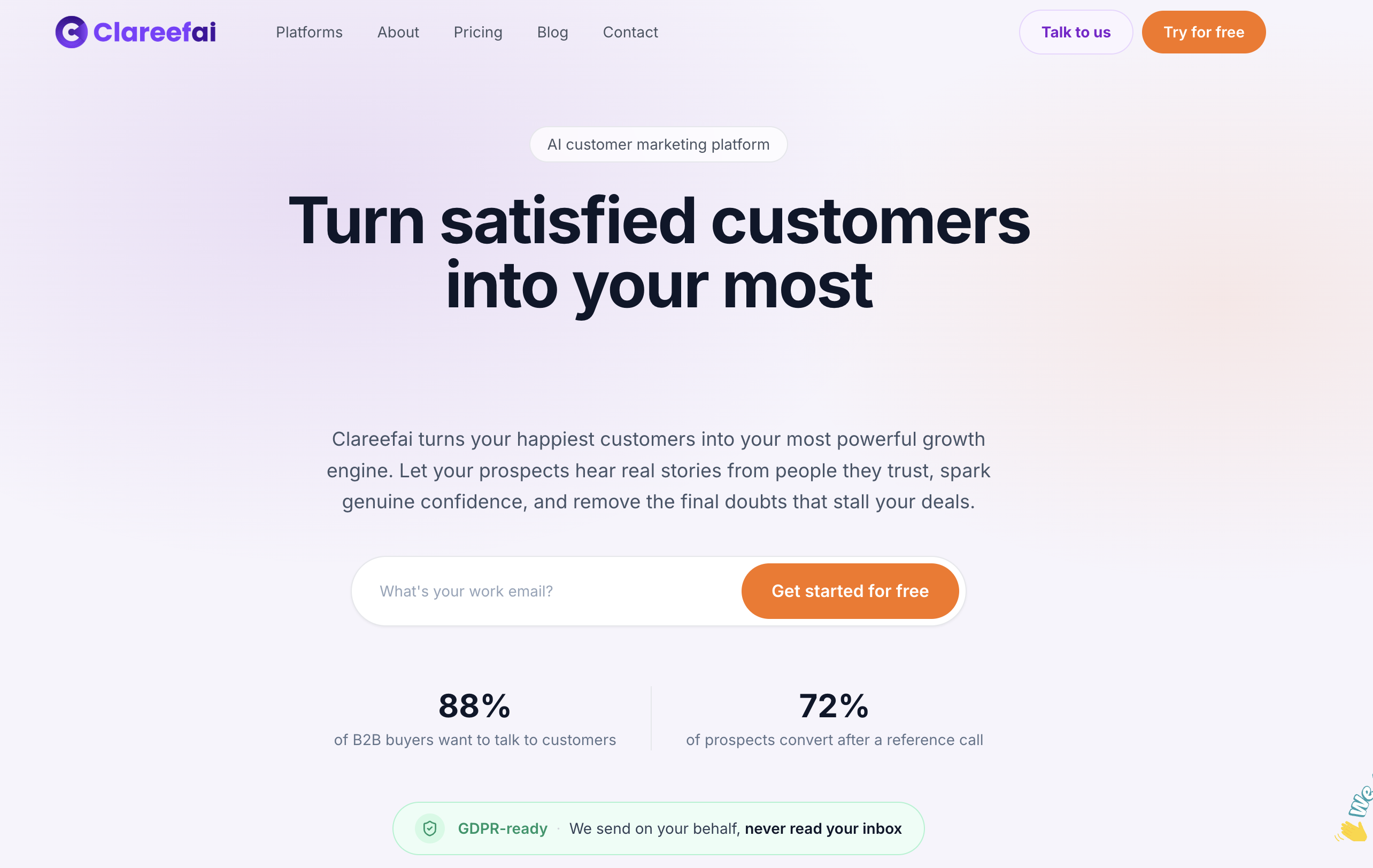
Clareefai’s platform applies real-time data synchronization to the testimonial and review layer of your sales funnel. When a customer submits a review, updates their profile, or completes a reference call, that data surfaces immediately across your CRM integrations, sales dashboards, and public-facing channels. No manual exports, no overnight batch jobs, no sales rep working from a testimonial that no longer reflects the customer’s current situation. The platform’s GDPR-compliant architecture keeps all of that data secure and role-controlled as it moves.
If you want to see how unified testimonial management translates into faster deal cycles, explore the use cases on the Clareefai solutions page and start a free trial to see the real-time sync features in your own environment.
Useful sources for further research and implementation planning
These sources support architecture decisions, SLA benchmarks, and implementation patterns discussed throughout this article.
- What Is Data Synchronization? — Oracle: Authoritative definition distinguishing synchronization from integration; useful for aligning terminology in design documents.
- Real-Time Data Sync: What It Is and Why It Matters — Stacksync: Practitioner-focused overview with Gartner-cited analysis on decision-making speed and AI dependency.
- Real-Time Data Integration — IBM: IBM’s perspective on AI dependency on data freshness and the strategic implications for organizations building ML-driven workflows.
- Set MSP Response Times — NinjaOne: Concrete SLA context for managed service providers; the 15-minute acknowledgment window example comes from this source.
- Data Synchronization: What It Is and How to Sync Data — HubSpot: Accessible explanation of synchronization concepts for business and marketing audiences; good for onboarding non-technical stakeholders.
Recommended
Share Article
Stay Updated
Get the latest insights on customer advocacy and SaaS growth delivered to your inbox.