B2B Procurement: Testimonial Software Pricing, 12 Month TCO & Checklist
B2B Procurement: Testimonial Software Pricing, 12 Month TCO & Checklist
Most B2B teams should expect to pay between $250 and $1,250 or more per month for testimonial software, metered by seats, spaces, or video volume rather than a flat rate. Starter plans handle basic text collection; growth plans unlock video and automation; enterprise pricing goes quote-based once you need SSO, a DPA, or dedicated support. For mid-size and larger B2B organizations, some testimonial software fits the growth-to-enterprise range well, with published plans that scale with seat count and testimonial volume.
TL;DR:
- Testimonial software costs typically range from $250 to over $1,250 monthly, with prices based on usage metrics like video processing, seats, or spaces, not flat rates.
- Pricing plans often include free, starter, growth, and enterprise tiers, with features expanding as video volume and team size increase, and enterprise prices requiring custom quotes.
- Key cost drivers include video processing and storage, additional spaces or brands, seat counts, outreach volume, and integration or API usage, which should be estimated upfront for accurate budgeting.
- Vendors usually bill monthly based on annual rates, and long-term contracts can offer savings but may lock you into capacity that does not match future growth; model your needs carefully before committing.
- For organizations with complex requirements, enterprise pricing involves detailed negotiations around brands, teams, automation, and security compliance, with quotes varying widely.
Table of Contents
- How Testimonial Software Pricing Actually Gets Structured
- What Do You Get at Each Pricing Tier?
- What Drives the Price Up (And How to Budget for It)
- Why Enterprise Testimonial Software Pricing Requires a Quote
- How Do You Choose the Right Plan Without Overpaying?
- What Are Typical Refund and Cancellation Terms?
- Does Committing to a Longer Contract Actually Save Money?
- Clareefai Pricing at a Glance
- Should You Replace Review Platforms With Owned Testimonial Software?
- Sources
- FAQ
How Testimonial Software Pricing Actually Gets Structured
Vendors rarely charge one flat number. They meter usage, and the meter they choose changes your bill more than the sticker price does.
You’ll typically run into one of these units, sometimes stacked together:
- Per space or per brand — you pay more as you add product lines, client accounts, or subsidiary brands, each needing its own collection page
- Per seat — pricing climbs with every teammate who needs login access to collect, moderate, or publish testimonials
- Per published video — a cap on how many video testimonials you can showcase, with overage charges or a forced upgrade past that number
- Per processed minute — some platforms bill by how much video you actually process, not just how many pieces you publish
- Per response — text-based tools sometimes count individual submissions, which matters if you run high-volume outreach campaigns
An independent 2026 roundup of B2B testimonial tools found that vendors rarely agree on which unit to meter, which makes side-by-side price comparisons deceptively hard. A $99 plan metered per response can cost more than a $200 plan metered per space, depending on your volume.
Billing cadence adds another wrinkle. Most vendors advertise a monthly figure that’s actually an annual rate divided by twelve. A pricing review of Testimonial.to points out that the “monthly” number on the page often only applies if you commit to a full year upfront; pay month to month and the real rate runs higher. Always ask whether the number in front of you assumes annual billing before you compare it to a competitor’s headline price.
The cost curve also bends differently depending on whether you’re running one brand or several. A single-brand SaaS company might stay comfortably on a starter or growth plan for years. An agency managing testimonial pages for eight client brands will blow through space limits fast, and per-space billing means that agency’s bill scales almost linearly with client count. Model your brand count before you shop, not after you sign.
What Do You Get at Each Pricing Tier?
Testimonial platforms tend to cluster around four tiers, and knowing what each one typically includes saves you from either overpaying or hitting a wall mid-quarter.
- Free tier. Expect hard caps: a handful of text testimonials, one or two video testimonials total, a single collection space, and widgets with minimal customization. Testimonial shows a free plan capped at 10 text and 2 video testimonials total, which is typical of the category. Free tiers exist to let you validate the workflow, not to run a real program.
- Starter tier. Text collection usually opens up here, sometimes to unlimited volume, but video often stays capped or limited to short clips. You’ll typically get custom branding, a connected domain, and a few basic integrations with your CRM or email tool.
- Growth or “ultimate” tier. This is where video limits loosen significantly or disappear, automated invitation sending kicks in, and you get API access plus more seats for a growing marketing or sales team. Vendor comparison tables, like the one on Testimonial Request’s pricing page, show this tier adding sub-team support and higher storage allowances alongside the video bump.
- Enterprise tier. Limits become negotiable rather than fixed. This is the tier where you’ll see single sign-on (SSO), SAML support, a signed data processing agreement (DPA), SOC 2 documentation on request, a named customer success contact, and support for invoicing or purchase orders instead of a credit card on file.
The jump from starter to growth is usually where video becomes the deciding factor. If your sales team wants video testimonials embedded on landing pages and inside proposals, don’t get lured by a cheap starter price. You’ll outgrow it within a quarter and end up paying migration friction on top of the upgrade fee. Trial the free tier first to validate real submission volume, since some vendors are notably more generous with free-tier video allowances than others, according to that same 2026 B2B software roundup.
What Drives the Price Up (And How to Budget for It)
The sticker price on a pricing page is rarely the number you’ll actually pay after month three. A handful of usage levers push costs up quietly, and none of them show up clearly until you’ve already onboarded.
Here’s what typically moves the needle on your actual bill:
- Video processing and storage — the single biggest driver, since video testimonials eat bandwidth and storage in a way text never does
- Per-space or per-brand billing — each new product line or client account you onboard adds a line item
- Seat count — every sales rep, marketer, or approver with login access can push you into the next seat bracket
- Automated invitation volume — high-frequency outreach campaigns can trigger overage fees if the plan caps monthly invites
- White-labeling and custom domains — often locked behind growth or enterprise tiers, sometimes billed as an add-on
- Integrations and API usage — CRM syncs and custom API calls can carry their own rate limits or per-call charges
- Onboarding or concierge fees — a one-time setup cost that some vendors bundle in and others bill separately
To build a real 12-month budget, translate each meter into your actual usage pattern before you sign anything. If a platform charges per processed minute or per published video, estimate your typical clip length and how many pieces you expect to publish monthly, then multiply that out across the year rather than trusting the advertised “starting at” number.
Pro Tip: Ask every vendor for two real add-on cost examples before you sign: what happens when you exceed your video cap mid-month, and what a second brand or space costs to add. Vendors will quote a clean base price all day; the add-on math is where budgets actually break.
If you run testimonial programs across multiple brands or client portfolios, model your intended number of spaces, contributors, and approvers up front, since per-space pricing scales fast for agencies and multi-brand operators. For agencies specifically, whitelabel pricing structures built for client-facing work carry their own version of this same per-account math worth comparing against.
Why Enterprise Testimonial Software Pricing Requires a Quote
Enterprise buyers rarely get a self-serve checkout button, and that’s by design. Once your requirements extend past collecting and publishing testimonials into how data moves through your organization, pricing stops being a simple per-seat calculation.
Procurement and IT will typically ask a vendor to itemize:
- The number of brands, spaces, or business units the contract needs to cover
- Total seats across sales, marketing, and customer success teams who need access
- Expected automation volume, including scheduled invitations and integration syncs
- Data retention requirements and where testimonial data physically lives
- Whether the vendor supports single sign-on, SAML, and role-based permissions
- Signed data processing agreement (DPA) terms for GDPR compliance
- SOC 2 documentation or equivalent security attestations on request
Enterprise pricing goes quote-based largely because these checkpoints require legal review, not just a credit card swipe. A vendor offering SSO and a signed DPA is selling a security posture, not just a feature toggle, and that posture takes time for your legal and security teams to evaluate against internal policy.
Procurement teams treat items like SSO and DPA support as gating requirements rather than nice-to-haves, which is why enterprise testimonial software deals commonly take weeks rather than minutes to close. That timeline is normal, not a sign something’s wrong with the vendor.
An enterprise tier is typically built around procurement patterns including GDPR-compliant data handling, identity verification, and role-based dashboards designed so security and legal teams have concrete answers before signing. If your organization has more than a few hundred employees and a formal procurement process, budget the enterprise conversation as a multi-week evaluation rather than an instant quote.
How Do You Choose the Right Plan Without Overpaying?
A clean three-step process keeps you from either underbuying and hitting walls in month two, or overbuying features you’ll never use.
- Measure your current needs first. Count your actual testimonial volume from the last quarter: how many text submissions, how many video pieces, how many brands or product lines need their own collection space, and how many teammates need login access.
- Map that usage to each vendor’s meters. Take the numbers from step one and run them against each vendor’s actual metering unit, whether that’s per space, per seat, per published video, or per processed minute. This is where a cheap-looking plan often turns expensive once your real volume hits it.
- Request quotes and compare total cost of ownership over 12 months, not the headline monthly number. Ask each vendor to quote your exact model rather than comparing generic tier prices.
When you request quotes, ask these ten questions directly:
- How is video metered, and what happens past the cap?
- What does adding an extra space or brand cost?
- Is there an overage fee for automated invitation volume?
- Are widget placements or customizations limited by tier?
- What does white-labeling cost, and is it bundled or separate?
- Are there API rate limits, and what happens if we exceed them?
- What’s the support SLA, and is there a named contact?
- Is there a separate onboarding or setup fee?
- What are the exact trial terms, including length and feature access?
- What’s the cancellation policy if we need to leave mid-term?
Treat vague answers as a red flag. A vendor who can’t give you a clear number for “what happens when we exceed the video cap” is a vendor who plans to surprise you with that charge later.
What Are Typical Refund and Cancellation Terms?
Most testimonial software runs on a standard SaaS cancellation model: cancel anytime, and you retain access through the end of your current billing period, with no partial-month refund for monthly plans. Annual plans are where the terms diverge sharply between vendors, so read this section of any contract closely before you commit to a year upfront.
Some vendors offer a prorated refund if you cancel an annual plan within a defined window, often the first 30 days, similar to a standard trial-to-paid conversion policy. Others treat annual commitments as non-refundable past the initial trial period entirely. Neither approach is wrong, but the difference matters enormously if your team is still validating whether video testimonials will actually move pipeline before locking in twelve months of spend.
Ask specifically about what happens to your published testimonials and collected video assets if you cancel. Some platforms let you export everything; others restrict access to your own collected content once the subscription lapses, which can leave you rebuilding social proof from scratch with a new vendor. Get this in writing, not as a verbal assurance from a sales rep, before you sign an annual contract.
This kind of software often runs on no long-term contracts by default, with monthly or annual billing options available, which keeps the cancellation conversation simple for teams still validating fit.
Does Committing to a Longer Contract Actually Save Money?
Annual billing almost always beats month-to-month on a per-month basis, typically by a meaningful margin once you annualize the comparison. That’s standard across SaaS, and testimonial software is no exception. The catch is that the “monthly” figure advertised on most pricing pages already assumes you’re paying annually, so a month-to-month buyer often pays a noticeably higher effective rate without realizing it until the first invoice lands.
Multi-year commitments show up mostly at the enterprise tier, where a vendor might offer a locked rate in exchange for a two or three-year term. That trade makes sense if your testimonial volume and brand count are stable and predictable. It makes far less sense if you’re a growing team likely to add brands, seats, or video volume within that window, since you’ll be stuck at a contract size that no longer matches your usage.
The safest sequence: trial or run month-to-month for at least one full quarter to validate real usage patterns, then move to annual once you know your actual volume. Skipping straight to a multi-year enterprise commitment before you’ve measured a single quarter of usage is how teams end up paying for capacity they never touch.
Clareefai Pricing at a Glance
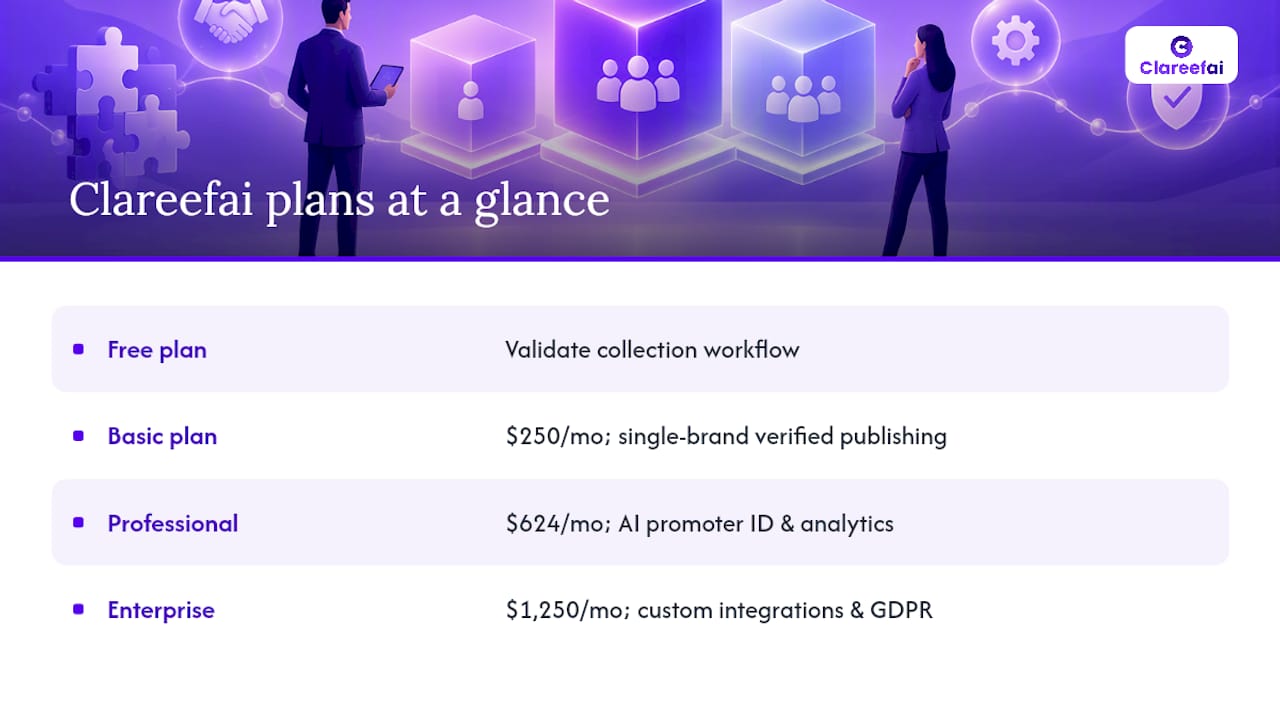
Clareefai maps four plans to four distinct points in a B2B team’s growth curve, and matching yours correctly up front saves a mid-year upgrade scramble.
The Free plan suits teams still testing whether owned testimonial collection fits their sales motion, letting you validate the workflow before any spend commitment. The Basic plan, at $250 per month, fits smaller marketing or sales teams running a single-brand testimonial program who need verified collection and basic publishing without enterprise overhead. The Professional plan, at $624 per month, targets growing teams that need AI-driven promoter identification, multi-channel publishing, and analytics dashboards across a larger contributor base. The Enterprise plan, at $1,250 per month, is built for organizations that need custom integrations, white-label deployment, GDPR-compliant data handling, and a named success contact guiding rollout across multiple teams.
What separates Clareefai from a generic collection tool at any tier is the verification layer underneath every testimonial. Instead of publishing anonymous quotes that prospects have learned to discount, Clareefai’s AI-driven analysis identifies your strongest customer advocates and connects prospects directly with verified promoters through testimonials, comments, and video reviews. For a sales team running late-stage deals, that’s the difference between a quote a buyer can dismiss and a reference they can actually trust.
If you’re evaluating fit for your team size, the Clareefai platform overview walks through how verification and publishing work together, and marketing teams specifically can see how testimonials get repurposed across campaigns on the solutions page for marketers. When you’re ready to see real numbers against your own volume, visit the Clareefai pricing page to start a trial or request a tailored enterprise quote.
Should You Replace Review Platforms With Owned Testimonial Software?
Owned testimonial software and public review platforms solve different problems, and treating them as competing budget lines is a mistake most marketing teams make once and regret. Review platforms drive discovery: a prospect searching for options finds you through star ratings and volume. Owned testimonial software drives conversion: it controls exactly which verified customer voice a specific prospect sees at the exact moment they’re deciding.
Sales teams should prioritize owned testimonial workflows whenever the goal is closing a specific deal rather than winning broad visibility. A verified video testimonial from a customer in the prospect’s industry, surfaced during a proposal stage, does work a five-star aggregate rating simply can’t do. Review platforms can’t be sequenced into a sales funnel; owned testimonial software can.
The practical test: if your sales cycle involves late-stage objection handling, run a trial of owned testimonial software against your current close rate for one quarter and see whether verified, contextual proof moves deals that generic reviews never touched.
— ClareefAi
Sources
- Testimonial
- Best testimonial and social proof software for B2B 2026 | destackd
- Testimonial.to Pricing Review (2026): Plans & Value
- Pricing | Testimonial Request
FAQ
What Is the Best Tool for Collecting Testimonials?
The best tool depends on whether you need simple text collection or verified, video-inclusive social proof for B2B sales. For mid-size and enterprise teams that need identity verification, AI-driven promoter matching, and CRM integration, Clareefai’s Professional plan at $624 per month covers most growth-stage needs, with Enterprise at $1,250 per month for larger security and integration requirements.
Where Can I Buy Testimonials?
You can’t legitimately buy testimonials from real customers; what you can buy is software that helps you collect, verify, and publish authentic testimonials from people who’ve actually used your product. Paying for fabricated reviews violates most platform policies and erodes buyer trust once discovered, so the safer investment is a verified collection workflow rather than purchased content.
What Are the Different Types of Testimonials?
The main types are written text testimonials, video testimonials, star ratings and reviews, case studies, and reference calls where a prospect speaks directly with an existing customer. B2B buyers tend to trust video and reference calls most heavily, since both are harder to fabricate than a written quote.
How Can I Create Testimonials?
Start by identifying your happiest customers, typically through NPS scores or renewal conversations, then send a structured, low-friction request for a written or video testimonial. Platforms like Clareefai automate this by using AI to flag your most impactful advocates and sending automated, verified collection invitations across email, in-app prompts, or post-support touchpoints.
Recommended
Share Article
Stay Updated
Get the latest insights on customer advocacy and SaaS growth delivered to your inbox.