How AI Transforms Sales Enablement for Sales Leaders
AI is a real-time coach, content curator, and productivity engine for sales enablement, surfacing the right content and next best actions at the exact moment sellers need them. The role of AI in sales enablement has shifted from a nice-to-have experiment to a core operational lever, with measurable outcomes showing up in ramp time, win rates, and pipeline creation.
Here is what enablement leaders are seeing in practice:
- Time savings: Agent users expect AI to cut prospect research time by ~34% and content creation time by ~36%, freeing sellers to spend more time with buyers.
- Action completion: One pilot combining unified data, encoded playbooks, and agentic delivery saw action completion jump from roughly 8% to 38%, generating $37 million in pipeline.
Pro Tip: Before you read further, identify the single biggest time drain on your sellers’ week. That is almost always the right first use case to pilot.
Key Takeaways
AI in sales enablement delivers the highest ROI when you fix data quality first, embed AI into existing seller workflows, and ground generative outputs in verified customer evidence.
| Point | Details |
|---|---|
| Push beats pull | AI that delivers next best actions into seller workflows outperforms static content libraries; organizations using NBAs are 2.6x more likely to achieve commercial growth. |
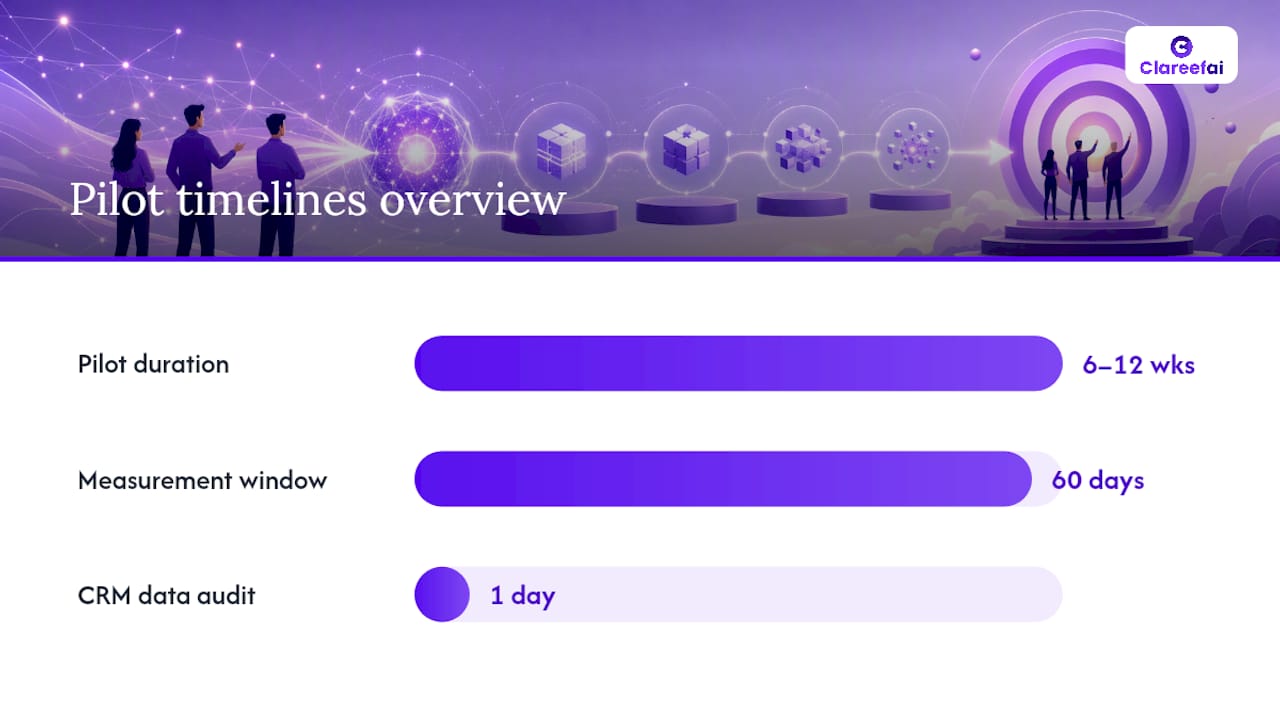
| Pilot narrow, then expand | Select 1–2 use cases, define success metrics upfront, and run a 6–12 week pilot before scaling to additional teams. |
| Data hygiene is the prerequisite | Unified, accurate CRM data determines agent accuracy; audit and fix the five most common data quality issues before your pilot starts. |
| Ground outputs in verified evidence | Link AI-generated content to authenticated testimonial IDs to prevent hallucinations and build seller and buyer trust. |
| Measure three KPIs | Track time saved, action completion rate, and win-rate delta monthly to maintain executive sponsorship and justify expansion. |
Table of Contents
- What AI in sales enablement actually means
- Practical AI use cases that move the needle in sales enablement
- Benefits teams report and how to measure AI impact
- Key risks and governance guardrails you need in place
- How to pilot and scale AI in sales enablement
- Ground AI outputs with verified testimonials and trusted data
- What enablement leaders should prioritize this quarter
- Clareefai helps you ground AI with verified customer evidence
- Sources
What AI in sales enablement actually means
Sales enablement has traditionally relied on content libraries sellers rarely visit. IBM describes AI-enabled sales enablement as converting those static libraries into dynamic, push-based systems that surface timely content and coaching at scale. Understanding the terminology helps you make smarter buying and building decisions.
Four terms worth pinning down:
- Generative AI: Large language models (LLMs) that produce new text, such as email drafts, call summaries, or personalized proposals, from a prompt and context.
- Predictive (traditional) ML: Algorithms trained on historical data to score leads, forecast deals, or flag churn risk. No text generation involved.
- Agentic AI: Systems that plan, execute multi-step tasks, and loop back to check results autonomously, such as researching a prospect, drafting an outreach sequence, and logging the activity in your CRM without a seller lifting a finger.
- Conversation intelligence: AI that transcribes, analyzes, and extracts insights from calls and meetings, flagging objections, competitor mentions, and coaching moments.
The push vs. pull distinction matters more than most teams realize. A pull system waits for sellers to search a content library. A push system detects the deal stage, buyer persona, and recent activity, then delivers the right asset or next best action (NBA) directly into the seller’s workflow. Gartner found that organizations providing AI-enabled next best actions are 2.6x more likely to achieve commercial growth than those that do not.
Consider the difference in practice: a generative AI tool drafts a follow-up email personalized to a prospect’s LinkedIn activity and recent earnings call. Both run in the background. The seller sees one clear prompt: “Send this email and request an exec intro.” That is push enablement working as designed.

Practical AI use cases that move the needle in sales enablement
Bain identified roughly 25 candidate use cases across the sales lifecycle and recommends starting narrow. Below are the highest-value applications, ranked roughly by speed-to-impact.
- Automated content creation: AI drafts emails, proposals, battle cards, and one-pagers from deal context. Sellers edit rather than write from scratch, cutting prep time significantly.
- Contextual content recommendations: Platforms like Seismic analyze deal stage, industry, and buyer role to push the most relevant asset. Sellers stop guessing which case study to send.
- Content hygiene and version control: AI flags outdated assets, identifies duplicates, and routes stale content for review. Spekit uses AI-driven nudges to keep knowledge cards current without manual audits.
- Conversation intelligence and call summarization: Tools transcribe calls, extract key moments, and auto-populate CRM fields. Sellers recover 20–30 minutes per call that previously went to manual note-taking.
- Guided selling and next best actions: AI reads deal signals and recommends the next step, such as scheduling a demo, sharing a pricing sheet, or escalating to a manager. Salesforce’s Einstein surfaces these NBAs directly inside the CRM record.
- Lead scoring and prioritization: Predictive models rank inbound leads by conversion likelihood, so reps work the right accounts first rather than the loudest ones.
- Prospecting and sequence generation: AI researches target accounts, identifies trigger events, and drafts personalized outreach sequences. This is where AI-driven marketing strategies and sales enablement increasingly overlap, with shared content workflows feeding both functions.
- Personalized onboarding and coaching: AI identifies skill gaps from call recordings and assigns targeted micro-learning. New reps ramp faster because coaching is tied to their actual conversations, not a generic curriculum.
- Forecasting and pipeline analytics: ML models analyze historical win/loss patterns, deal velocity, and engagement signals to produce more accurate forecasts than spreadsheet-based gut calls.
- AI agents for autonomous task execution: Agents handle research, CRM logging, and follow-up scheduling without seller input. The seller’s job shifts to judgment and relationship work, while the agent handles the operational overhead.
Pro Tip: Score each use case on two axes: business value (revenue impact, time saved) and implementation feasibility (data availability, integration complexity). Pilot the top-right quadrant first.
Benefits teams report and how to measure AI impact
The benefits of AI in sales enablement are real, but they require deliberate measurement wiring to prove value to executives. Here are the KPIs that matter most and how to track them.
Core metrics to instrument from day one:
- Research and content prep time saved: Track via seller time-logging or CRM activity timestamps before and after AI deployment.
- Action completion rate: Measure the percentage of AI-recommended next best actions sellers actually execute. The Salesforce pilot that moved this from 8% to 38% used playbook encoding as the key lever.
- Ramp time: Compare time-to-first-deal for AI-coached cohorts versus historical baselines.
- Win rate lift: Segment deals where AI content recommendations were used versus those where they were not.
- Forecast accuracy: Compare AI-generated forecast variance against quota attainment over rolling quarters.
- Pipeline created by agents: Tag pipeline sourced from agent-initiated outreach sequences to isolate agent ROI.
Benchmark context: The 2026 Salesforce State of Sales survey of more than 4,000 sales professionals found AI and AI agents are the top growth tactic for the year. Agent users project roughly 34% less time on prospect research and 36% less on content creation.
A minimal measurement setup does not require a complex data warehouse. Tag AI-assisted activities in your CRM with a custom field (“AI-assisted: yes/no”), run a monthly cohort comparison, and report three numbers to leadership: time saved, action completion rate, and win-rate delta. That is enough to justify expanding the pilot.
Key risks and governance guardrails you need in place
AI in sales enablement carries real risks that can erode seller trust fast if you do not address them upfront. Technical reviews of current LLM capabilities confirm that even production-grade models hallucinate, drift, and fail unpredictably on out-of-distribution inputs.
The main risks to manage:
- Hallucinations: AI generates confident-sounding but factually wrong content, especially dangerous in proposals and competitive battle cards.
- Poor data hygiene: Garbage CRM data produces garbage recommendations. Agents trained on stale or duplicate records will surface irrelevant actions.
- Disconnected systems: AI tools that cannot read deal context from your CRM default to generic outputs that sellers ignore.
- Privacy and security: Customer conversation data fed into third-party LLMs may violate data processing agreements or GDPR obligations.
- Ethical bias: Lead scoring models trained on historical data can encode past biases, systematically deprioritizing certain segments.
- Over-automation: Removing human judgment from high-stakes moments, such as pricing negotiations or executive conversations, creates brand risk and generic interactions.
Governance checklist to implement before you scale:
- Data provenance: Document which data sources feed each AI model and who owns data quality for each source.
- Human-in-the-loop review levels: Define which outputs require seller review (all external-facing content) versus which can be auto-executed (CRM field updates, internal summaries).
- Approval workflows: All AI-generated content going to buyers must pass through a seller review step, at minimum.
- Model and prompt documentation: Log which model version and prompt template produced each output so you can audit and roll back.
- Logging and auditing: Retain AI output logs for a defined period to support compliance reviews and bias audits.
Pro Tip: Ground AI outputs against verified customer testimonials and reference data before they reach sellers. When a generated case study excerpt links back to a real, authenticated customer story, sellers trust it and buyers find it credible. Platforms like Clareefai verify and contextualize that evidence so it can serve as a reliable anchor for AI-generated claims.
How to pilot and scale AI in sales enablement
Scaling AI in sales enablement does not start with technology. It starts with a clear problem statement and clean data. Bain’s research is direct: process redesign, focused pilots, data cleanup, and executive sponsorship are prerequisites, not afterthoughts.
Step-by-step pilot blueprint:
- Select 1–2 high-impact use cases based on your value-feasibility scoring (see Section 3 pro tip). Conversation intelligence and content recommendations are common first choices because they require minimal process redesign.
- Define success metrics before you start. Pick two or three from the KPI list above and set a target delta (e.g., action completion rate from 15% to 30% in 60 days).
- Identify data sources and owners. Map which CRM fields, content repositories, and conversation data the AI needs. Assign a data owner for each source.
- Run a 6–12 week pilot with a single team or territory. Keep the scope tight enough to move fast and measure cleanly.
- Measure, document, and expand. After the pilot, present results against your pre-defined metrics. If the signal is positive, expand to the next team with the same playbook.
Change management is where most pilots stall. Sellers adopt AI when it saves them time inside tools they already use. Embedding AI into your CRM, email client, or Slack, rather than asking sellers to open a separate dashboard, removes the “toggle tax” that kills adoption. Salesforce’s enablement team embeds AI recommendations directly into CRM records for exactly this reason.
Additional change management priorities:
- Manager enablement: Train managers to coach using AI call insights, not just to review transcripts.
- Seller incentives: Tie early AI adoption to recognition, not just quota. Sellers who see peers winning with AI follow faster.
- Adoption tracking: Monitor feature usage weekly during the pilot. Low usage is a signal to simplify, not to add features.
Pro Tip: Before your pilot kicks off, run a one-day CRM data audit. Identify the five most common data quality issues (missing fields, duplicate accounts, stale contacts) and fix them. Unified, accurate data is the single biggest determinant of agent accuracy and seller trust.
Ground AI outputs with verified testimonials and trusted data
Gartner reports that 61% of B2B buyers prefer a rep-free buying experience, which means the content AI surfaces must be accurate and credible without a seller present to correct it. Grounding generative outputs in verified customer evidence is the most practical way to prevent hallucinations from reaching buyers.
Methods to ground AI outputs effectively:
- Link generated content to authenticated testimonial snippets: When AI drafts a case study paragraph, attach a canonical testimonial ID from a verified source so the claim is traceable.
- Pull verified case-study excerpts as context: Feed real, approved customer outcomes into the prompt context window rather than letting the model infer results.
- Attach reference-call summaries as supporting evidence: Summarized reference calls, tagged by industry and use case, give AI a factual anchor for competitive positioning claims.
- Use quality flags and provenance fields: Tag each testimonial asset with its verification status, collection date, and approving stakeholder so AI retrieval filters out unverified content automatically.
Implementation pattern for data modeling:
Integrate these fields with your CRM so deal context automatically pulls the most relevant, verified testimonials. Teams using verified social proof to accelerate the sales cycle report faster prospect decision-making because buyers encounter consistent, credible evidence at every touchpoint.
Pro Tip: Build an automated check that blocks any AI-generated external-facing content from delivery if it references a customer outcome not tied to a verified testimonial ID. This single guardrail prevents the most damaging hallucinations. Clareefai’s platform can serve as the verified evidence layer that feeds this check.
What enablement leaders should prioritize this quarter
Most enablement teams are sitting on a gap between AI ambition and AI execution. The teams closing that gap fastest share a few habits worth adopting now.
Start with data hygiene, not tools. Every AI capability in your stack depends on CRM data quality. A week spent cleaning duplicate accounts and filling missing fields returns more value than any new AI subscription. This is not glamorous, but it is the foundation.
Embed AI where sellers already work. A separate AI dashboard that sellers must remember to open will not get used. Push recommendations into Salesforce, HubSpot, Outreach, or whatever surface your team lives in. Adoption follows convenience.
Define guardrails before you scale. External-facing AI content without a human review step is a liability. Set the rule now: sellers approve all buyer-facing outputs. Build the approval workflow into your CRM or content platform before the pilot ends.
Invest in manager enablement. Managers who understand how to coach using AI call insights, and who model that behavior for their teams, drive adoption faster than any training program aimed at individual sellers. One organizational change that consistently accelerates scaling: promote a senior seller into a “workflow architect” role responsible for designing AI-assisted playbooks. That person bridges the gap between what AI can do and how sellers actually work.
Measure three things and report them monthly. Time saved, action completion rate, and win-rate delta. Keep the dashboard simple enough that a VP can read it in 90 seconds. Complexity kills executive sponsorship.
Clareefai helps you ground AI with verified customer evidence
AI-generated content is only as trustworthy as the evidence behind it. Clareefai gives your enablement team a verified, centralized library of customer testimonials, reference calls, and case studies that AI can pull from with confidence. Every asset is identity-verified, tagged by industry and use case, and integrated with your CRM so the right proof point surfaces at the right deal stage.
If you want to see how verified testimonials improve win rates in practice, explore the Clareefai testimonial management use case or review how AI outreach paired with verified social proof drives B2B results.
Sources
For benchmarking and use-case prioritization:
- Salesforce Announces State of Sales Report for 2026 - Salesforce
- AI in Sales Enablement | IBM
- AI Is Transforming Productivity, but Sales Remains a New Frontier | Bain & Company
For governance and risk management:
For buyer behavior and testimonial grounding:
Recommended
Share Article
Stay Updated
Get the latest insights on customer advocacy and SaaS growth delivered to your inbox.