How to Collect and Localize Multilingual Testimonials

Do this: collect testimonials in the customer’s native language, preserve the original text or recording, and localize each one with document-context translation plus human post-editing before it ever reaches a prospect. That sequence, in that order, is what separates a testimonial that converts from one that reads like it was run through a translator on the way out the door.
Here’s the roadmap. Over the next appropriate initial timeframe of a few weeks to a few months:
- Weeks 1-2: Audit current testimonial sources and add a language field to every intake form.
- Weeks 2-4: Localize your request emails for your top three non-English markets.
- Weeks 4-8: Set up document-context translation and a human review pass, then track Time to Edit.
- Weeks 8-12: Add a “show original” toggle to your testimonial display and start measuring conversion lift by locale.
A platform like Clareefai can run this entire workflow in one place, but the sequence matters more than the tool.
Key Takeaways
Multilingual testimonials build trust fastest when they’re collected natively, localized with document-context AI and human review, and displayed with the original visible alongside the translation.
| Point | Details |
|---|---|
| Collect natively first | Ask customers for feedback in their preferred language rather than translating English quotes after the fact. |
| Localize, don’t just translate | Use document-context AI plus a human linguist post-edit to preserve tone and emotional impact. |
| Show the original | A visible “show original” toggle builds transparency and reduces skepticism about altered quotes. |
| Track Time to Edit | Measure how much human editing AI-translated drafts need to gauge workflow efficiency. |
| Use a unified platform | Clareefai centralizes verification, original storage, localization, and publishing in one workflow. |
Table of Contents
- Why Multilingual Testimonials Matter for Trust and Conversion
- How Do You Collect Testimonials in Multiple Languages?
- Translation vs Localization: Which One Protects the Testimonial’s Voice?
- How Should You Display Testimonials in Multiple Languages?
- How Do You Verify and Measure Multilingual Testimonials?
- What Most Localization Advice Gets Wrong
- Run Multilingual Testimonials Without the Manual Handoffs
- Frequently Asked Questions
- Sources
Why Multilingual Testimonials Matter for Trust and Conversion
A testimonial written in the buyer’s own language does something a translated one can’t: it sounds like it came from someone who actually understands their situation. When a prospect in Munich reads a quote from a German customer, in German, the trust signal lands instantly. Swap in an English quote with a translation badge, and you’ve just reminded them they’re reading marketing copy filtered through software.
Cultural expectations also shape what “credible” even looks like. A glowing five-star review with exclamation points reads as authentic in the U.S. and slightly suspicious in Japan, where understated, specific praise carries more weight. Localization adapts these cultural markers beyond a word-for-word swap, which is why the same testimonial needs different framing for different markets.

Mismatched language is its own credibility problem. Ecommerce research shows that a localized product page paired with English-only reviews creates a jarring trust gap for shoppers who expected a coherent experience.
What this means for your roadmap:
- Native-language testimonials shorten the trust-building step in the buyer journey.
- Mismatched page-and-review language actively works against conversion, not just neutrally.
- Cultural tone matters as much as literal accuracy.
How Do You Collect Testimonials in Multiple Languages?
Most teams get this backward. They collect testimonials in English, then translate them for other markets, which strips out the nuance that made the quote persuasive in the first place. Collect natively instead. Here’s how.
- Localize the request itself. Don’t translate your English review-request email word for word. Rewrite it for the market, adjusting formality, greeting conventions, and even the ask itself, since a direct “leave us a review” lands differently in France than in the Philippines.
- Detect locale, but let customers override it. Use browser or account-level locale detection to set a default language, then add an explicit language chooser so a bilingual customer can pick what’s comfortable.
- Capture full metadata at intake. Every submission should log language, role, company, product used, and explicit permission to publish, not just the quote.
- Preserve the original format. If someone records a video testimonial in Portuguese, keep that file as the source of truth. Never let the translated transcript become the only record.
- Follow up in their language. Configuring emails to send in a customer’s preferred language measurably increases response rates compared to a one-size-fits-all English follow-up.
Pro Tip: Add a single dropdown to your intake form asking “What language would you like to give feedback in?” Response rates jump when customers realize they’re not required to write in English, even if they’re fluent.
Translation vs Localization: Which One Protects the Testimonial’s Voice?
Translation converts words. Localization converts meaning, tone, and cultural context, which is the entire reason a testimonial persuades anyone in the first place. A literal translation can be grammatically perfect and still flatten the enthusiasm, sarcasm, or industry-specific praise that made the original quote worth publishing.
The workflow that actually works at scale is a hybrid one: run the full testimonial through a document-context translation tool, not a sentence-by-sentence engine, then have a marketing linguist do a light post-edit for tone and idiom. Enterprise localization providers point to Time to Edit as the metric that tells you whether this workflow is actually efficient. A short TTE means your AI-plus-human pipeline is producing near-final copy; a long one signals your translation layer needs better context or better prompting.
Large-scale localization succeeds when AI supplies consistent terminology across dozens of testimonials, and a human linguist calibrates the emotional intensity that a market actually expects to hear.
Watch for these common failure points:
- Sentence-level machine translation that loses the connective tissue between clauses.
- Industry jargon translated too literally, so a “churn reduction” quote becomes nonsensical.
- Emotional flattening, where an excited customer starts to sound like they’re reading a warranty card.
How Should You Display Testimonials in Multiple Languages?
The order of preference is simple: show the visitor’s native language first, fall back to a high-quality localized translation second, and only default to the original untranslated text as a last resort. Review platforms increasingly build this logic in with on-load or on-demand translation modes that store the original text behind the scenes.
That “behind the scenes” part matters. A visible “show original” toggle does more for credibility than most marketing teams expect, since it tells skeptical buyers nothing was rewritten to sound better than the customer meant. Pair it with a small language badge (a flag icon or two-letter code) so nobody wonders whether they’re reading a translation.
For video, always include subtitles and a full transcript in both languages. That’s not optional for accessibility, and it also lets your sales team skim a quote in seconds instead of replaying a two-minute clip.
- Native language first, localized translation second, original as fallback.
- Visible “show original” toggle plus a clear language badge.
- Subtitled and transcribed video in both source and target languages.
- Sales reps need a filtered view by market and language, not just a public-facing widget.
Mismatched language between page and review content is one of the more common, and most fixable, conversion leaks on multilingual sites.
How Do You Verify and Measure Multilingual Testimonials?
A testimonial in an unfamiliar language is harder to sanity-check, which makes verification more important, not less. Identity proofing, confirming the person actually holds the title and works at the company they claim, and consent capture at the point of submission should happen before a quote ever gets translated, not after.
Build a metadata taxonomy from day one: tag each testimonial by market, language, product used, and use case, so your sales team can pull up “German manufacturing customer, cost-reduction use case” in seconds during a call. This is the difference between a testimonial archive and a sales enablement asset your reps actually use.
Track these four numbers monthly:
- Localized response rate: the percentage of native-language requests that convert to a submitted testimonial.
- Conversion lift: how localized testimonial pages perform against English-only or untranslated equivalents.
- Time to Edit: how much human editing your AI-translated drafts require before publishing.
- Reuse rate: how often a single testimonial gets pulled into sales decks, emails, or case studies across teams.
Pro Tip: Review your reuse rate quarterly. A testimonial that never gets pulled into a sales conversation isn’t earning its place in the library, no matter how polished the translation.
What Most Localization Advice Gets Wrong
Most guides on this topic stop at “translate your reviews,” as if swapping languages were the whole job. That advice undersells the problem. The real risk isn’t a bad translation, it’s a technically accurate one that still fails to persuade, because tone, emphasis, and cultural credibility markers got lost somewhere between the source quote and the published page.
The conventional wisdom also treats verification as separate from localization, when it should happen first. A translated quote from an unverified source doesn’t just risk embarrassment, it undermines every other testimonial on the page once a skeptical prospect starts asking questions.
If you take one thing from this guide, prioritize the original. Keep it. Show it. Let a “show original” toggle do the trust-building work that no disclaimer ever will. Everything else, the workflow, the metrics, the tooling, exists to support that one principle. Teams that start with translation as a checkbox task tend to end up with a testimonial library nobody in sales actually trusts enough to use, which defeats the purpose of collecting them at all.
Run Multilingual Testimonials Without the Manual Handoffs
Most teams manage this workflow across three or four disconnected tools: a form for intake, a translation vendor for localization, a spreadsheet for metadata, and a CMS for publishing. Every handoff between them is where consistency, and originals, get lost. Clareefai runs the whole thing in one system.
The platform verifies customer identity at intake, stores the original submission alongside every translated version, and gives you role-based dashboards so marketing, sales, and management see exactly the metadata they need. Because translation and review happen inside one connected workflow rather than passed between vendors, teams see faster publishing across locales and a shorter Time to Edit on every localized quote. GDPR-compliant storage and real-time analytics mean you’re not just collecting multilingual testimonials, you’re measuring which ones actually move deals forward. Start by exploring Clareefai’s solutions for testimonial collection and verification, or look at how unified testimonial management improved win rates for one team already running this playbook. Request a demo to see your own workflow mapped onto the platform before you commit to anything.
Frequently Asked Questions
What’s the difference between translating and localizing a testimonial? Translation converts the words. Localization adapts tone, cultural references, and emphasis so the quote reads as persuasive to the target market, not just accurate.
Should we show the original language alongside the translation? Yes. A “show original” toggle builds transparency and reassures skeptical buyers that the quote wasn’t reworded to sound better than the customer meant.
How do we get more customers to submit testimonials in their own language? Send request emails and forms localized for the market, not translated word for word, and add an explicit language chooser so customers know they don’t have to respond in English.
What is Time to Edit, and why does it matter for multilingual testimonials? Time to Edit measures how much human editing an AI-translated testimonial needs before publishing. A shorter TTE means your translation workflow is producing near-final copy efficiently.
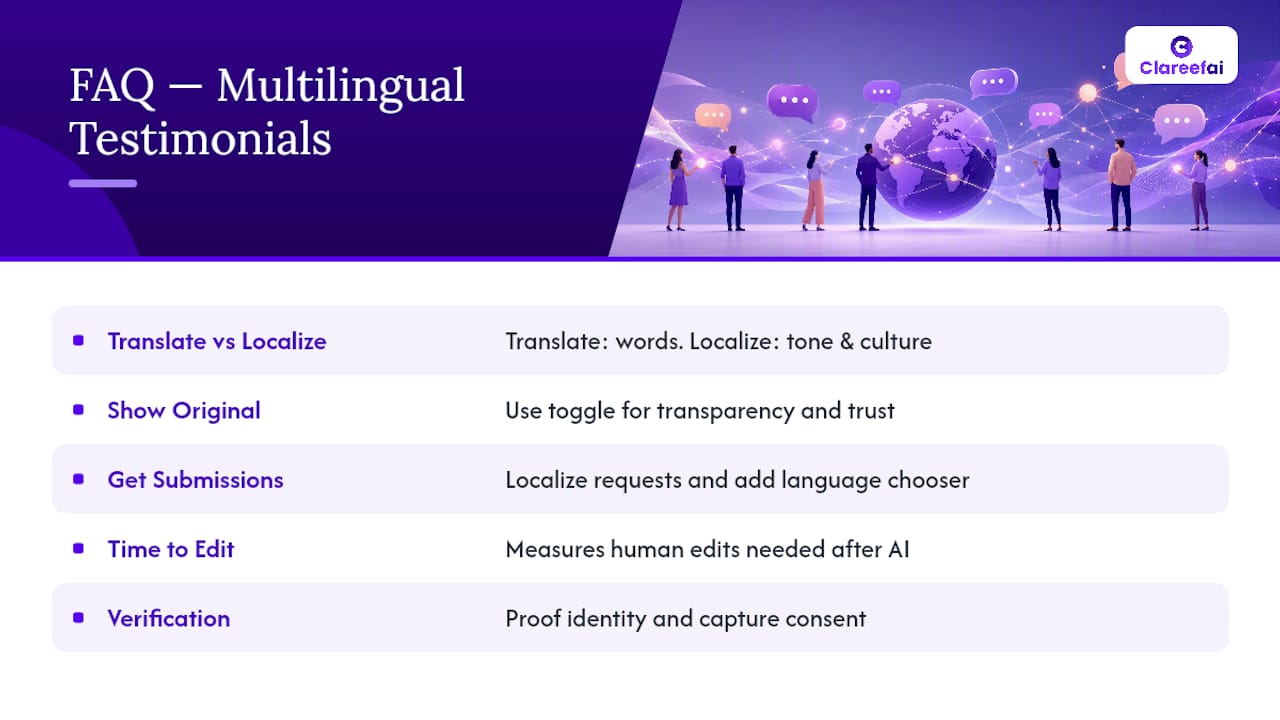
Do multilingual testimonials need the same verification as English ones? Identity proofing and consent capture matter even more for translated quotes, since language differences make it harder for readers to independently vet the source.
Sources
- Translation vs localization vs internationalization: what’s the difference
- Customer success stories that sound real in every language - Translated
- Configuring Multilingual Review Emails
Recommended
Share Article
Stay Updated
Get the latest insights on customer advocacy and SaaS growth delivered to your inbox.